Cart Abandonment: Why Buyers Leave at the Last Step (And How to Get Them Back)

@nadolconverts
Kacper Nadol

Cart abandonment is the most frustrating leak in ecommerce because it happens to buyers who had already decided to purchase. They added the item, they committed, and then something made them leave. This article breaks down why it happens, what to fix first, and how to recover the sales that are slipping away at the final step.
Why Cart Abandonment Is the Most Painful Leak
There is a hierarchy of frustration when it comes to losing conversions, and cart abandonment sits at the very top of it.
When a visitor leaves a product page, you lost someone who was still deciding. That is normal. Most people who look do not buy, and that is true in every store and every category. But when someone abandons a cart, you lost someone who had already decided. They evaluated the product, they were convinced, they committed enough to add it to their cart, and then they walked away at the final step. That is not a browser who was never going to buy. That is a buyer you had and lost.
This is what makes cart abandonment both the most painful leak and the most valuable one to fix. These are the most recoverable conversions in the entire funnel because the intent was already there. The buyer did not need convincing that they wanted the product. They got to the cart on their own. Something specific in the final stretch caused them to leave, and that something is usually identifiable and fixable.
The average cart abandonment rate across ecommerce hovers around 70%, which means most stores are losing the majority of buyers who got all the way to the cart. Even a modest improvement in that number translates directly into revenue, because these buyers were already at the doorstep. The broader picture of where ecommerce funnels leak is here: Ecommerce Conversion Rate Optimization: What Actually Moves Revenue
The Number One Cause: Unexpected Costs
If there is a single dominant cause of cart abandonment, it is unexpected costs appearing late in the process.
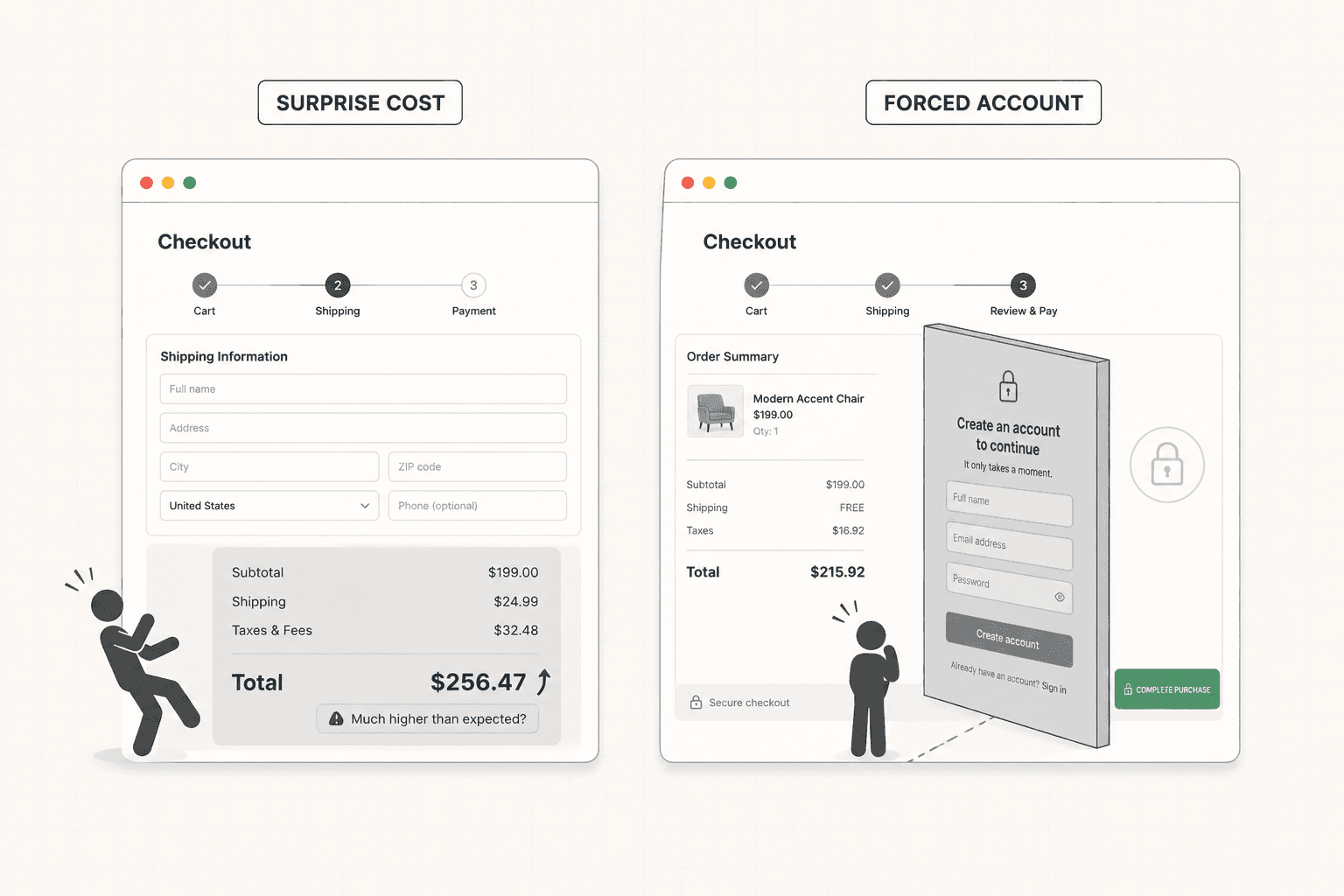
The buyer adds an item at a price they have accepted. They proceed toward checkout. And then shipping fees, taxes, handling charges, or other costs appear that they did not see coming. The total is suddenly higher than the number they had agreed to in their head, and the gap between the expected price and the actual price triggers abandonment. Even when the additional costs are reasonable, the surprise itself does the damage. The buyer feels like the real price was concealed, and that feeling overrides the rational acceptance of the cost.
This is consistently the most cited reason for cart abandonment across ecommerce research, and it is also one of the most fixable. The solution is to remove the surprise by surfacing the full cost earlier. Show shipping costs on the product page or in the cart, not at the final checkout step. Make any thresholds for free shipping visible so the buyer knows what they are working toward. Be transparent about taxes and fees before the buyer reaches the moment of final commitment.
The principle is simple. The buyer should never encounter a number at checkout that is meaningfully higher than what they expected. When the final total matches the expectation the buyer built earlier, the surprise that causes abandonment disappears. The cost itself is rarely the problem. The unexpectedness of it is.
The Second Cause: Forced Account Creation
Requiring buyers to create an account before they can complete a purchase is one of the most common and most avoidable causes of abandonment.
The buyer is ready to pay. They have their card out. And the store interrupts the transaction to demand that they create an account, choose a password, and commit to an ongoing relationship before they can buy the thing they came to buy. For many buyers, this is the moment they decide it is not worth the effort, especially for a first purchase from a store they are still evaluating.
The fix is guest checkout. Let the buyer complete the purchase with just the information needed to fulfill the order, and offer account creation after the transaction rather than as a barrier before it. Many stores find that guest checkout recovers a meaningful share of the buyers who would otherwise abandon at the account-creation step. The account can still be offered, framed around the benefit to the buyer, once the purchase is complete and the friction no longer threatens the sale.
The underlying lesson is that the checkout is not the place to pursue secondary goals like account creation, newsletter signups, or data collection. The checkout has one job: complete the purchase. Anything that interrupts that job to serve a different objective costs conversions among buyers who were ready to pay.
The Third Cause: Checkout Friction
Beyond surprise costs and forced accounts, the general friction of the checkout itself drives a significant share of abandonment.
Every additional step, every unnecessary field, every moment of confusion in the checkout flow is a place where a ready buyer can slip away. A checkout that asks for more information than the transaction requires, that spreads the process across more steps than necessary, or that creates uncertainty about what happens next, accumulates friction that adds up to lost sales.
The checkout that converts well is ruthlessly streamlined. It asks only for what is genuinely needed to complete and fulfill the order. It minimizes the number of steps between deciding to buy and completing the purchase. It makes the path forward obvious at every point, so the buyer never has to stop and figure out what to do next. It validates input helpfully rather than punishing small errors with lost progress.
Payment options are part of this. A buyer who cannot pay the way they prefer often abandons rather than adapting. Offering the payment methods your specific audience expects, including the digital wallets and newer options that many buyers now default to, removes a friction point that is entirely within your control. The smoother and faster the buyer can move from cart to confirmation, the fewer of them leak out along the way.
Mobile is where checkout friction concentrates most severely. A checkout that is merely tedious on desktop can be genuinely painful on a phone, where every field requires tapping, the keyboard covers half the screen, and small touch targets produce errors. Since mobile is now a large share of ecommerce traffic, a checkout that was designed for desktop and adapted for mobile is usually leaking a significant portion of mobile buyers at the final step. The principle of removing friction at every step applies across the whole funnel: Why Your Landing Page Doesn't Convert: 9 Real Reasons (And What to Fix First)
The Fourth Cause: Second Thoughts the Cart Does Not Address
Some cart abandonment is not about friction at all. It is about the buyer having a last-moment hesitation that the cart and checkout do nothing to resolve.
The buyer is about to commit and a doubt surfaces. Is this the right choice? Can I find it cheaper elsewhere? What if it does not work out? Do I really need this right now? These are the natural second thoughts that arise at the moment of purchase, and a cart that does nothing to address them leaves the buyer alone with their hesitation at exactly the wrong moment.
The carts and checkouts that convert well anticipate these second thoughts and resolve them in context. A clear, generous return policy visible at the cart reduces the fear of making the wrong choice. A reminder of the value or the specific benefit the buyer is about to get reinforces the decision they already made. Trust signals near the payment step reduce the anxiety of handing over card details. Reassurance about what happens after the purchase removes uncertainty about the next steps.
This is the same objection-handling principle that drives conversion everywhere, applied to the final moment. The buyer's last-second doubts are predictable. A cart that addresses them keeps the buyer moving toward completion. A cart that ignores them leaves the door open for the hesitation to win. The way proof and reassurance reduce last-moment doubt is covered here: Social Proof: How to Use It So It Actually Converts (Not Just Decorates)
Recovering the Carts You Still Lose
Even a well-optimized checkout will lose some carts, and there is a second layer of opportunity in recovering those buyers after they leave.
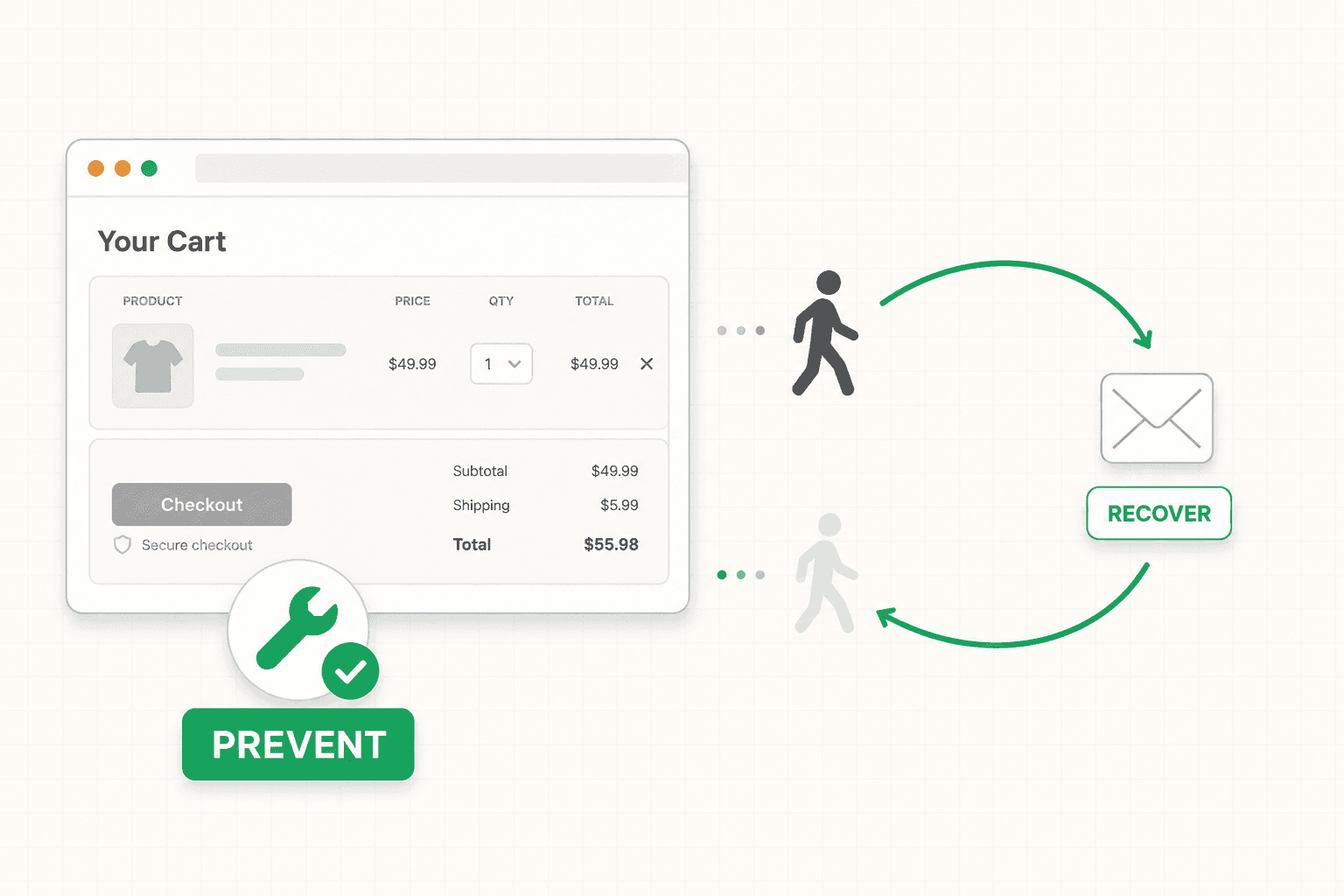
Cart abandonment recovery, done well, can win back a meaningful share of buyers who left. The most common mechanism is a follow-up sequence, usually email, that reminds the buyer of what they left behind and gives them an easy path back to complete the purchase. These work because the buyer already wanted the product. They are not being sold something new. They are being reminded of something they already chose and given a frictionless way to finish.
The strongest recovery sequences are timely, helpful, and not annoying. A reminder sent within a few hours, while the intent is still warm, tends to perform better than one sent days later. The message works best when it is useful rather than pushy, addressing the likely reason for abandonment rather than just nagging. If the buyer left because of an unexpected cost, a recovery message that addresses shipping or offers a small incentive can resolve the exact thing that caused the abandonment.
Recovery is a second chance, not a replacement for fixing the underlying problem. A store with a high abandonment rate caused by a broken checkout should fix the checkout first, because recovering a fraction of buyers who leave is far less efficient than preventing them from leaving in the first place. Recovery captures the carts you lose despite a good checkout. It does not compensate for a checkout that drives buyers away.
How to Diagnose Your Own Cart Abandonment
If your store is losing buyers at the cart, the path to fixing it starts with understanding where and why they are leaving.
Look at where in the checkout the abandonment happens. Most analytics setups can show you which step buyers reach before leaving. If they abandon at the moment shipping costs appear, you have a surprise-cost problem. If they leave at the account-creation step, you have a forced-account problem. If they drop off across the form fields, you have a friction problem. The step where they leave points directly to the cause.
Go through your own checkout as a buyer, on both desktop and mobile. Note every moment of friction, every surprise, every point where you had to stop and think or hunt for information. Each one is a place where real buyers are leaking. Pay particular attention to mobile, where the friction is usually worse and the losses larger.
Check when costs first become visible. If the full cost only appears at the final step, you have likely found a major source of abandonment. Surfacing those costs earlier is often one of the single highest-impact fixes available.
If you are losing carts and cannot pinpoint why, a structured diagnosis maps the specific leak points in your checkout before any changes are made, so the fixes are targeted rather than guessed. See how the 48h Audit works
The Short Version
Cart abandonment is the most painful leak in ecommerce because it happens to buyers who had already decided to buy. It is also the most recoverable, because the intent was already there.
The dominant cause is unexpected costs appearing late, which the buyer experiences as concealment. Surface the full cost early and the surprise disappears. The second is forced account creation, which guest checkout solves. The third is general checkout friction, especially on mobile, which a streamlined flow reduces. The fourth is last-moment second thoughts that a cart with reassurance and clear policies can resolve.
Recovery sequences win back a share of the buyers you still lose, but fixing the checkout prevents the loss in the first place, which is always more efficient than recovering after the fact.
These buyers were at the doorstep. Find what is turning them away at the final step and the recovered revenue is some of the easiest in the entire funnel.
Keep reading