Social Proof: How to Use It So It Actually Converts (Not Just Decorates)

@nadolconverts
Kacper Nadol

Almost every website has social proof. Almost none of it is doing the conversion work it could. Logos chosen for recognition, testimonials that say nothing specific, reviews buried where no one sees them. This article breaks down what makes social proof actually convince a buyer, and where most of it fails.
Why Most Social Proof Does Nothing
Walk through almost any website and you will find social proof. A logo grid on the homepage. A testimonials section somewhere in the middle. Star ratings on product pages. A "trusted by thousands" line near the top. The proof is there. It is just not doing much.
The reason is that most social proof is treated as a credibility decoration rather than a conversion tool. It exists to make the site look established and trustworthy in a general sense, which is a real but limited job. What it usually does not do is resolve the specific doubts that are actually stopping a particular buyer from converting, at the moment those doubts arise.
Social proof that converts is different from social proof that decorates. It is specific rather than generic. It is relevant to the particular buyer rather than impressive in the abstract. And it is placed where the relevant doubt forms rather than grouped in a section that exists because every website is supposed to have one. The gap between these two kinds of social proof is the gap between proof that moves conversion and proof that just sits on the page looking credible.
Specific Beats Impressive
The most common failure in social proof is choosing it for how impressive it looks rather than how convincingly it addresses a buyer's actual concern.
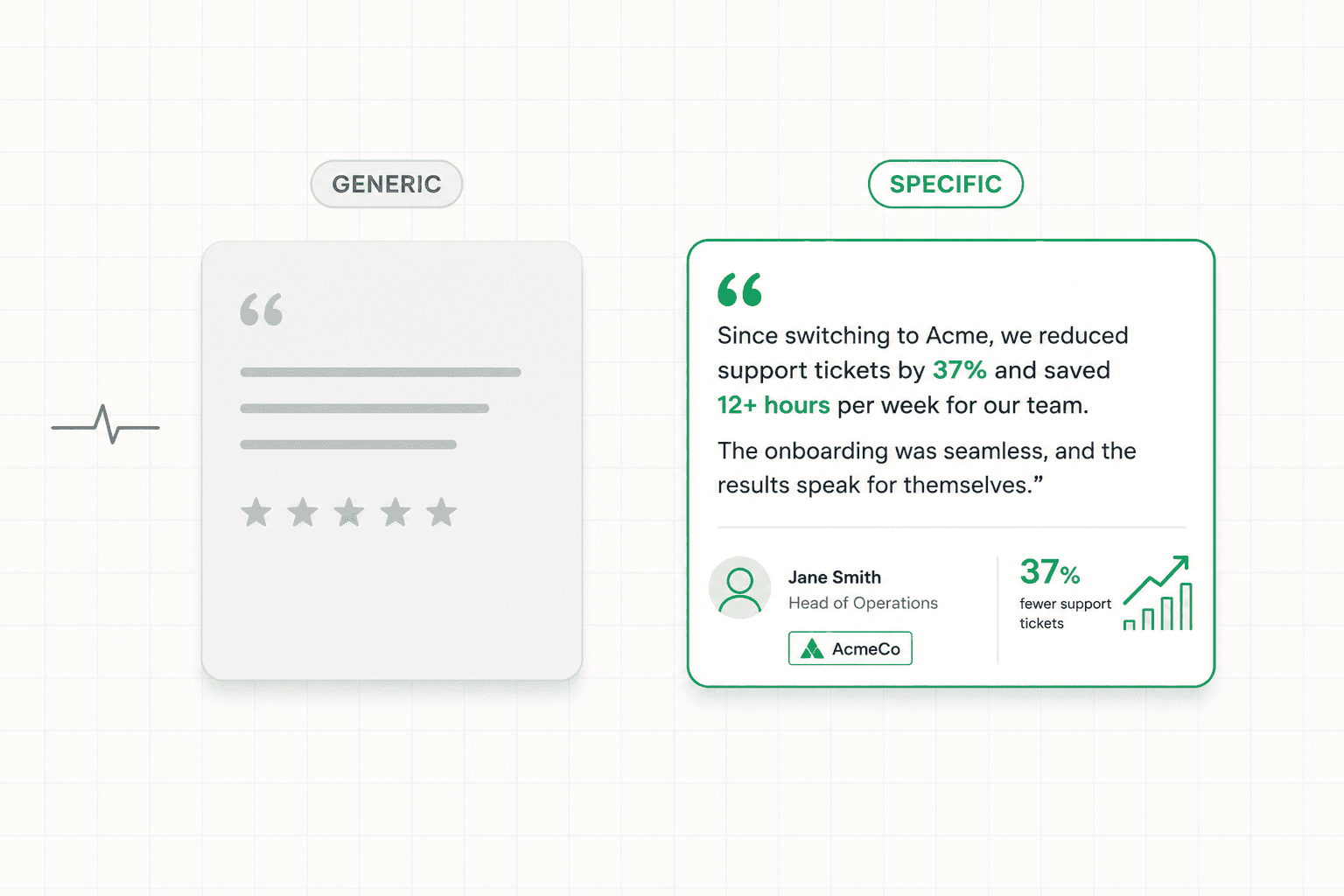
A testimonial that says "Amazing product, highly recommend!" is impressive in tone and empty in substance. It tells the buyer that someone was happy, but it does not tell them why, what changed, or whether that person's situation resembles their own. It is positive noise.
A testimonial that says "We were skeptical it would integrate with our existing stack, but setup took an afternoon and we were seeing results within the first week" is doing real work. It names a specific doubt (integration difficulty), addresses it (setup took an afternoon), and provides a concrete outcome (results within a week). A buyer carrying that same doubt reads it and feels their specific concern resolved.
The same principle applies to every form of social proof. A logo grid of impressive companies is less convincing to a specific buyer than one logo from a company that clearly resembles their own situation. A "10,000 customers" statistic is less convincing than a specific case study showing a measurable result for a relevant use case. A five-star average is less convincing than a detailed review from someone with the buyer's exact concern.
Specificity is what makes social proof credible and relevant. Impressive-but-vague proof signals that the company has customers. Specific proof signals that customers like this buyer got the specific result this buyer wants. The second one converts. This is the same specificity principle that drives all conversion copy: Landing Page Copywriting: What Actually Makes It Convert
Placement Is Half the Work
Even strong, specific social proof underperforms when it is placed wrong. And most social proof is placed wrong, grouped into a dedicated section rather than positioned where it would actually do work.
The logic of placement is simple. A buyer moves through a page accumulating questions and doubts as they go. At each point, a different concern is forming. The job of social proof is to resolve those concerns at the moment they arise, which means the proof needs to be near the part of the page that raises the concern, not collected in a testimonials carousel three screens away.
A testimonial about ease of implementation belongs near the section discussing implementation. A case study about ROI belongs near the pricing or value discussion. A review addressing product durability belongs near the product details that raise durability questions. Proof placed at the point of doubt resolves the hesitation in real time. Proof grouped at the bottom of the page gets seen by a fraction of visitors and resolves doubts that formed long ago, if it resolves them at all.
This is why a dedicated testimonials section, while not useless, is one of the least effective ways to use social proof. The proof is doing its weakest work there, separated from the moments where it would actually matter. The stores and sites that convert best distribute their proof throughout the page, positioning each piece next to the concern it addresses, while sometimes also maintaining a fuller proof section for buyers who want to dig deeper. The architecture of placing proof at the point of doubt is covered in detail here: B2B Landing Page: What Makes It Actually Work
The Different Types of Social Proof and When Each Works
Social proof comes in several forms, and each does its best work in different situations. Using the right type for the right concern matters.
Testimonials work best for resolving specific doubts and humanizing the value. A good testimonial from a relevant buyer addressing a specific concern is one of the most versatile and convincing forms of proof. The key is specificity and relevance over volume and polish.
Case studies work best for buyers who need detailed evidence before a significant commitment. They are heavier proof, suited to higher-consideration decisions where the buyer wants to see the full story of how a similar customer got a result. A case study link placed near a relevant claim gives serious buyers the depth they need without cluttering the page for everyone else. The way case studies work as proof assets shows up across real client work: see the projects
Logos work best for quick credibility signaling, but only when relevant. A logo grid says "established companies trust this." Its weakness is that recognition does not equal relevance. One logo from a company resembling the buyer's situation often does more than a grid of impressive but unrelated names.
Reviews and ratings work best for products and offers where volume of opinion matters, like ecommerce. Aggregate ratings provide a quick confidence signal, but the individual reviews, especially specific ones addressing particular concerns, do the deeper convincing.
Numbers and statistics work best as supporting signals rather than primary proof. "10,000 customers" or "2 million hours saved" can reinforce credibility, but they are abstract and less convincing on their own than specific stories. They support the case rather than carry it.
User-generated content works best for products where seeing real people use the thing builds confidence. Photos and videos from actual customers, especially in ecommerce and lifestyle products, resolve the doubt of how the product looks and works in real life better than polished brand imagery.
The mistake is treating all social proof as interchangeable. Each type has a job it does best, and matching the type to the specific concern and the specific buyer is what makes the proof work.
The Authenticity Problem
Social proof only works if the buyer believes it, and buyers have become skilled at detecting proof that feels manufactured.
Testimonials that are too polished, too uniform, or too perfect read as fabricated. Reviews that are all five stars with no detail feel curated. Stock-photo headshots attached to quotes feel fake. Statistics with no source feel invented. Each of these triggers the buyer's skepticism, and once that skepticism is triggered, the proof does the opposite of its job, actively reducing trust instead of building it.
Authentic social proof has texture. Real testimonials include specific details, occasional imperfections, and the natural unevenness of how actual people talk. Real reviews include a range of opinions, not just perfect scores. Real names, real companies, real faces, and real specifics all signal that the proof is genuine. The slight messiness of real proof is more convincing than the polish of manufactured proof.
This is why the most convincing social proof is often the least produced. A screenshot of an actual message from a customer. A review in the customer's own unedited words. A photo a customer actually took. These feel real because they are, and that realness is what makes them convince. The instinct to clean up and polish social proof often makes it less effective, because it strips out exactly the texture that signals authenticity.
Where to Get Social Proof You Do Not Have
Many businesses underuse social proof not because they lack it but because they have not collected it systematically.
The strongest source is usually existing customers. A short, specific testimonial request to happy customers, asking about their specific situation, what changed, and what result they got, produces proof far more convincing than anything written internally. The key is asking for specifics rather than general praise, which means asking questions that prompt detailed answers rather than just "would you recommend us."
Sales calls and customer conversations are another rich source. The specific language customers use to describe their results and their satisfaction is exactly the kind of specific, authentic proof that converts. Capturing these moments and turning them into testimonials, with permission, builds a library of relevant proof.
Reviews on third-party platforms, support interactions where customers express satisfaction, and social media mentions are all sources of authentic proof that often go uncollected. The businesses that use social proof well tend to have a system for capturing it continuously rather than scrambling to find it when they redesign a page.
For newer businesses with limited proof, the approach is to use what exists well rather than to fabricate. One genuine, specific, relevant testimonial used effectively converts better than a fake logo grid. Transparency about being early, combined with the real proof that exists, is more convincing than manufactured credibility that the buyer will see through. The way proof functions even with a thin evidence base is covered here: Why Your Landing Page Doesn't Convert: 9 Real Reasons (And What to Fix First)
How to Audit Your Own Social Proof
If you want to evaluate the social proof on your site, run through these questions.
Is your proof specific or generic? Read each testimonial, case study, and review on your site and ask whether it names a specific situation, addresses a specific concern, or provides a specific result. If it is just general praise, it is decorating rather than converting.
Is it relevant to your actual buyer? Do the logos, testimonials, and case studies resemble the situation of the buyer you are trying to convert? Or are they impressive but unrelated?
Is it placed where the doubt is? Walk through your page and check whether each piece of proof sits near the concern it would resolve, or whether it is grouped into a section away from the relevant moments.
Does it feel authentic? Read your proof as a skeptical buyer. Does any of it feel too polished, too perfect, or potentially fabricated? Authenticity is what makes proof believable.
Are you capturing new proof systematically? Or are you relying on whatever you happened to collect, scrambling for more only when you rebuild a page?
If your proof is generic, irrelevant, poorly placed, or thin, it is underperforming, and fixing it is often one of the higher-leverage conversion improvements available. A structured audit identifies where your proof is failing to convert before any changes are made. See how the 48h Audit works
The Short Version
Almost every site has social proof, and almost none of it is doing the conversion work it could.
Social proof converts when it is specific rather than impressive, relevant to the actual buyer rather than impressive in the abstract, placed at the point of doubt rather than grouped decoratively, and authentic rather than polished into something that triggers skepticism.
Different types of proof do different jobs. Testimonials resolve specific doubts, case studies provide depth for big decisions, logos signal quick credibility when relevant, reviews build confidence through volume, and user-generated content shows real use. Match the type to the concern.
The proof you have is probably underused. Make it specific, make it relevant, place it where the doubt forms, and keep it authentic. That is the difference between proof that decorates and proof that converts.
Keep reading