Ecommerce Conversion Rate Optimization: What Actually Moves Revenue

@nadolconverts
Kacper Nadol

Most ecommerce CRO advice is a pile of tactics with no diagnosis behind them. Add urgency, show reviews, simplify checkout. Sometimes these help. Often they do not, because the actual problem was somewhere else entirely. This article covers where ecommerce conversion really breaks down and what moves revenue rather than just the metric.
Why Most Ecommerce CRO Is Just Guessing
Search for ecommerce conversion advice and you will find the same list everywhere. Add urgency timers. Show social proof. Simplify the checkout. Add trust badges. Offer free shipping. Use exit-intent popups. Optimize your product images.
Every item on that list can help in the right situation. The problem is that the list is presented as universal, applied to every store regardless of where that specific store is actually losing sales. A store losing customers at the product page has a completely different problem than a store losing them at checkout, and applying checkout fixes to a product-page problem produces no result while everyone wonders why the conversion rate did not move.
Ecommerce conversion is a funnel with several distinct stages, and revenue leaks at specific points in that funnel rather than uniformly across it. The store that diagnoses where its specific leak is and fixes that specific leak will outperform the store that applies a generic checklist of best practices to a problem it never actually identified.
The useful version of ecommerce CRO starts with finding the leak, not with applying tactics. Everything else follows from the diagnosis.
The Ecommerce Funnel and Where It Leaks
The ecommerce journey breaks down into several stages, each with its own failure modes. Understanding which stage is leaking is the foundation of any real optimization work.
The landing or product page. Where the visitor first encounters the product. Leaks here usually come from unclear value, weak product presentation, missing information the buyer needs, or a mismatch between what the visitor expected and what they found. If visitors are arriving and leaving without engaging, the problem is here.
The product detail and consideration stage. Where the visitor evaluates whether to buy. Leaks here come from insufficient product information, weak or missing reviews, unclear shipping and return policies, poor product images, or unanswered questions that create hesitation. Visitors who engage with the product but do not add to cart are leaking here.
The cart. Where the visitor has committed enough to add the item but has not completed the purchase. Leaks here come from unexpected costs appearing late, a confusing path to checkout, second thoughts that the cart does nothing to address, or simply a cart that makes it easy to leave and hard to continue.
The checkout. Where the transaction completes or fails. Leaks here come from forced account creation, too many form fields, limited payment options, unexpected shipping costs revealed at the last moment, security concerns, or a checkout flow that is longer and more complicated than it needs to be.
Each of these stages is diagnosable from analytics. The drop-off between stages tells you where the leak is, and the size of each drop-off tells you which leak is costing the most. Fixing the biggest leak first is almost always the highest-leverage move, and it is impossible to know which leak is biggest without looking. The principle of diagnosing before intervening applies the same way to any conversion problem: Website Not Converting? Here's How to Find Out What's Actually Wrong
The Product Page Is Where Most Stores Underinvest
For most ecommerce stores, the product page is doing more conversion work than any other page, and it is usually the most underoptimized.
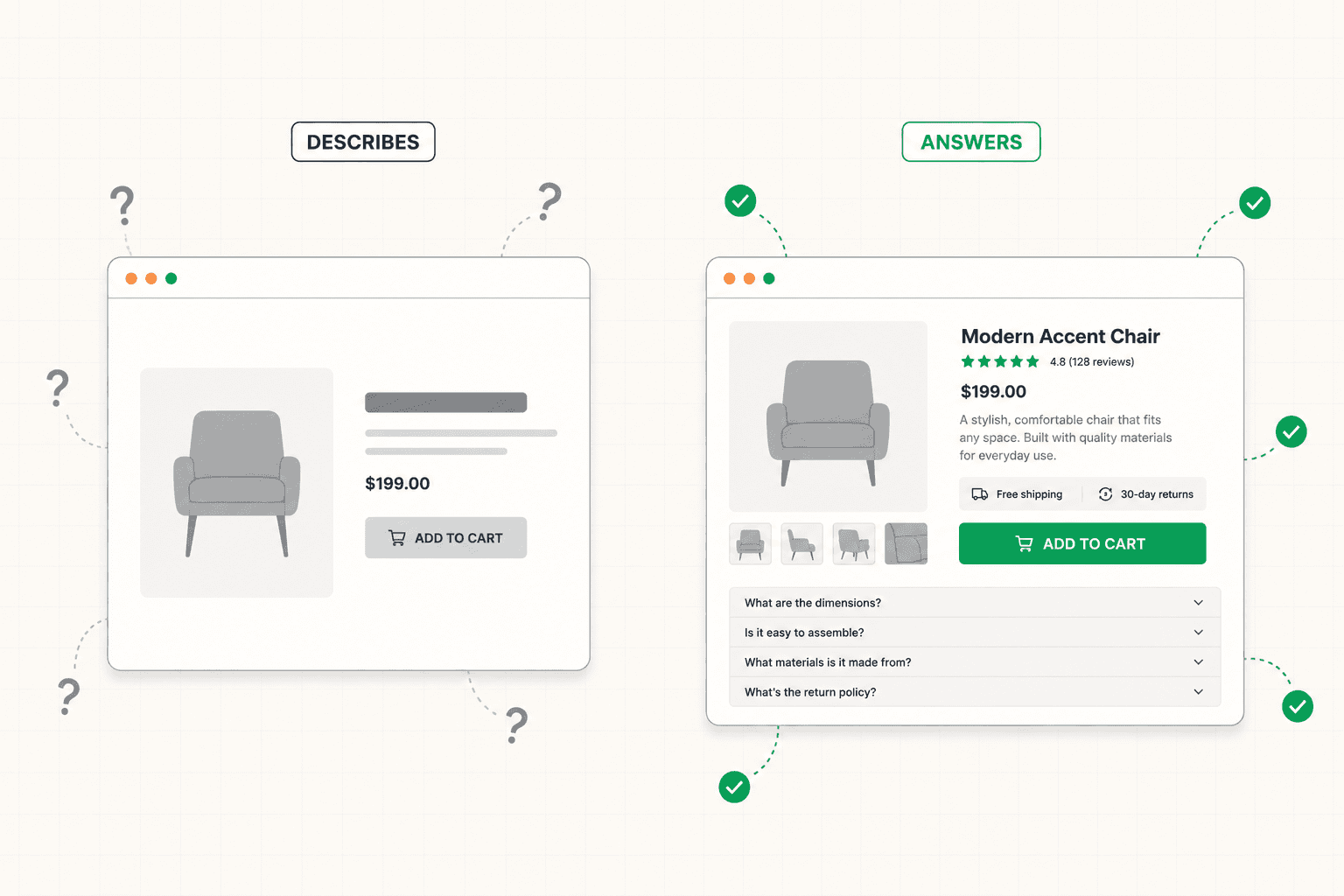
The product page has to do several things at once. It has to present the product clearly enough that the visitor understands exactly what they are getting. It has to answer the questions that would otherwise create hesitation. It has to provide enough proof to overcome the natural skepticism of buying something unseen. And it has to make the path to purchase obvious and low-friction.
Most product pages fail at one or more of these. The images are too few or too low quality to give the buyer confidence. The description focuses on features without addressing the buyer's actual questions. The reviews are buried or absent. The shipping and return information is hidden, forcing the buyer to hunt for it or guess. Each of these creates a moment of hesitation, and hesitation in ecommerce usually means a closed tab.
The product pages that convert well treat the buyer's uncertainty as the thing to solve. What does the buyer need to know before they will commit? What are they worried about? What would they need to see to feel confident? A product page built around answering these questions outperforms one built around describing the product, in the same way a landing page built around the buyer outperforms one built around the company. The same logic that drives landing page conversion applies here: Why Your Landing Page Doesn't Convert: 9 Real Reasons (And What to Fix First)
The Checkout Is Where Committed Buyers Get Lost
Cart abandonment is one of the most expensive problems in ecommerce because it happens to buyers who had already decided to purchase. They added the item. They committed. And then something in the checkout made them leave. These are the most recoverable conversions in the entire funnel because the intent was already there.
The most common checkout leaks are well documented and worth addressing systematically.
Unexpected costs appearing at the last step. Shipping fees, taxes, or handling charges that the buyer did not see until the final screen are the single biggest cause of cart abandonment. The buyer feels misled, even if the costs were technically disclosed somewhere, and they leave. Surfacing these costs earlier, ideally on the product page or at least in the cart, removes the late surprise that kills the sale.
Forced account creation. Requiring the buyer to create an account before purchasing adds friction at the worst possible moment. Guest checkout almost always recovers a meaningful percentage of these abandonments. The account can be offered after the purchase, not demanded before it.
Too many form fields. Every unnecessary field is a small reason to abandon. Asking for information the transaction does not actually require, or asking for it in a way that feels excessive, costs conversions. The checkout should ask for the minimum needed to complete the order and route it correctly.
Limited payment options. Buyers who cannot pay the way they prefer often leave rather than adapting. Offering the payment methods your specific audience expects, including the newer options younger buyers increasingly default to, removes a friction point that is entirely avoidable.
Security concerns. A checkout that does not feel trustworthy loses buyers at the moment they are about to enter payment details. Visible security signals, a professional checkout design, and a flow that feels solid all reduce the last-second hesitation.
The checkout is also where mobile matters most. A checkout that works on desktop but is frustrating on mobile is leaking a large share of modern ecommerce traffic. Every field, every tap, every step is more costly on a small screen.
What Actually Moves Revenue vs What Just Looks Like Optimization
A lot of ecommerce CRO activity produces motion without results. Knowing the difference saves time and budget.
Things that frequently move revenue:
Fixing the biggest leak in the funnel, identified through actual diagnosis rather than assumption. Improving product page clarity and proof for stores leaking at consideration. Removing checkout friction for stores leaking at the final step. Surfacing costs earlier for stores with high cart abandonment. Improving mobile experience for stores with a significant mobile share and a mobile-desktop conversion gap. Strengthening the product images and information for products where the buyer needs confidence before committing.
Things that frequently look like optimization but rarely move revenue much:
Urgency timers on stores where urgency is not real and the buyer knows it. Adding more trust badges to a checkout that does not have a trust problem. Endless A/B testing of button colors on a store with insufficient traffic to reach significance. Exit-intent popups that irritate more buyers than they recover. Redesigning the entire store because it feels dated when the actual leak is a specific fixable issue at one funnel stage.
The pattern is the same as in all conversion work. Targeted interventions based on diagnosis move the number. Generic tactics applied without diagnosis mostly produce activity. The case for fixing conversion before chasing more traffic applies directly to ecommerce: How to Improve Website Conversion Rate Without More Traffic
The Metrics That Matter in Ecommerce CRO
Conversion rate is the headline metric in ecommerce, but optimizing it in isolation can be misleading in the same way it is for lead generation.
A store can increase conversion rate by aggressively discounting, which moves the metric while eroding margin. It can increase conversion rate by pushing low-consideration impulse purchases, which moves the metric while reducing average order value. It can increase conversion rate by removing qualification friction, which moves the metric while increasing returns. In each case the conversion rate improves and the business does not.
The metrics worth watching alongside conversion rate are average order value, revenue per visitor, return rate, and customer lifetime value. Revenue per visitor in particular is often a more honest measure of ecommerce performance than conversion rate alone, because it captures both how many people buy and how much they spend, which conversion rate misses entirely.
An optimization that increases conversion rate while decreasing revenue per visitor is usually a net loss, even though it looks like a win on the surface. Tracking the fuller picture prevents the kind of optimization that improves the metric the team is watching while quietly hurting the business underneath. The same distinction between metric and business outcome applies across all conversion work: What Is a Good Conversion Rate for a Landing Page?
How the Strongest Ecommerce Stores Approach This
The stores that consistently convert well share an approach that has more to do with discipline than with any specific tactic.
They know where their funnel leaks because they look at the data rather than assuming. They fix the biggest leak first rather than spreading effort across every possible improvement. They build product pages around the buyer's uncertainty rather than around product description. They treat the checkout as a place to remove friction rather than a place to add upsells and distractions. They design for mobile as a primary surface, not an afterthought. And they track revenue per visitor and order value alongside conversion rate so they optimize the business rather than just the metric.
None of this requires a complete rebuild for most stores. It requires diagnosing the specific leak and fixing it, then moving to the next one. The compounding effect of fixing one real leak at a time produces more revenue than any single dramatic redesign usually does. If you want to see how this conversion-first thinking shows up in a real e-com build, the modue project is the most direct example: see the modue project
Before You Start Optimizing
If your ecommerce store is underperforming and you are tempted to start applying tactics, the highest-leverage first step is identifying where in the funnel you are actually losing the most revenue.
That single piece of information changes everything about what you should do next. A store leaking at the product page needs a different intervention than a store leaking at checkout, and applying the wrong fix to the wrong leak produces nothing but wasted effort. The diagnosis is what makes the work that follows targeted rather than speculative.
A structured audit maps the specific leak points in your funnel before any optimization begins, so you know exactly where to focus. See how the 48h Audit works
The Short Version
Ecommerce conversion is a funnel that leaks at specific points, not uniformly. The store that diagnoses where its specific leak is and fixes that leak will outperform the store applying a generic checklist of tactics to a problem it never identified.
The product page is where most stores underinvest, and it converts best when built around the buyer's uncertainty rather than the product's description. The checkout is where committed buyers get lost, usually to unexpected costs, forced account creation, excessive form fields, or mobile friction.
Track revenue per visitor and order value alongside conversion rate so you optimize the business rather than just the metric. And fix the biggest leak first, because the compounding effect of fixing one real leak at a time beats any single dramatic redesign.
Diagnose before you optimize. The leak is specific. The fix should be too.
Keep reading