AI Website Builders vs Hiring: What Actually Makes Sense for Your Business

@nadolconverts
Kacper Nadol

AI website builders have gotten good enough that the question is no longer whether they work, but when they are the right choice and when hiring someone is worth the cost. This article breaks down the real tradeoff, without the hype from the tool makers or the defensiveness from the agencies.
The Question Has Actually Changed
A few years ago, the question of whether to use an AI website builder or hire someone had an easy answer for any serious business. The AI tools produced generic, templated, obviously-automated results that no company with real commercial ambitions would want representing them. Hiring was the default for anyone who cared about the outcome.
That has changed, and pretending it has not is a mistake. AI website builders have gotten genuinely good. They can produce clean, modern, functional sites quickly and cheaply, and the gap between what they produce and what a competent freelancer produces has narrowed to the point where, for some businesses in some situations, the AI builder is the right choice.
But the tool makers overstate the case, and the agencies understate it, and neither is giving you an honest picture. The AI builder companies want you to believe you never need to hire anyone. The agencies want you to believe AI builders produce garbage. Both are selling something. The actual answer is a tradeoff that depends on your specific situation, and getting it right requires understanding what AI builders are genuinely good at, what they are still bad at, and what your business actually needs from its website.
What AI Website Builders Are Genuinely Good At
It is worth being honest about where AI builders have become a legitimately strong option, because dismissing them entirely is as wrong as overselling them.
AI builders are good at producing clean, functional sites fast. For a straightforward site with standard structure, an AI builder can get you from nothing to a live, decent-looking site in a fraction of the time and cost of hiring. The output is usually competent. Not exceptional, but competent, and competent is genuinely enough for some situations.
They are good at speed and iteration for early-stage needs. A founder who needs a site up quickly to validate an idea, test a market, or have a basic presence while the business finds its footing can get there faster with an AI builder than with any hiring process. The ability to generate, adjust, and republish quickly suits situations where the site needs to exist more than it needs to be optimized.
They are good at cost efficiency for simple needs. For a business where the website is not a primary conversion surface, where it exists to provide basic information and legitimacy rather than to drive significant revenue, the cost difference between an AI builder and hiring is hard to justify spending. If the site does not need to do heavy commercial work, paying for heavy commercial work is a poor use of budget.
They are good at removing the technical barrier. A non-technical person who could never have built a site themselves and cannot afford to hire can now produce something functional. This is a genuine democratization, and it serves a real need for the many businesses that fall below the threshold where hiring makes sense.
What AI Website Builders Are Still Bad At
The limitations are just as real as the strengths, and they cluster around exactly the things that separate a website that looks fine from a website that actually converts.
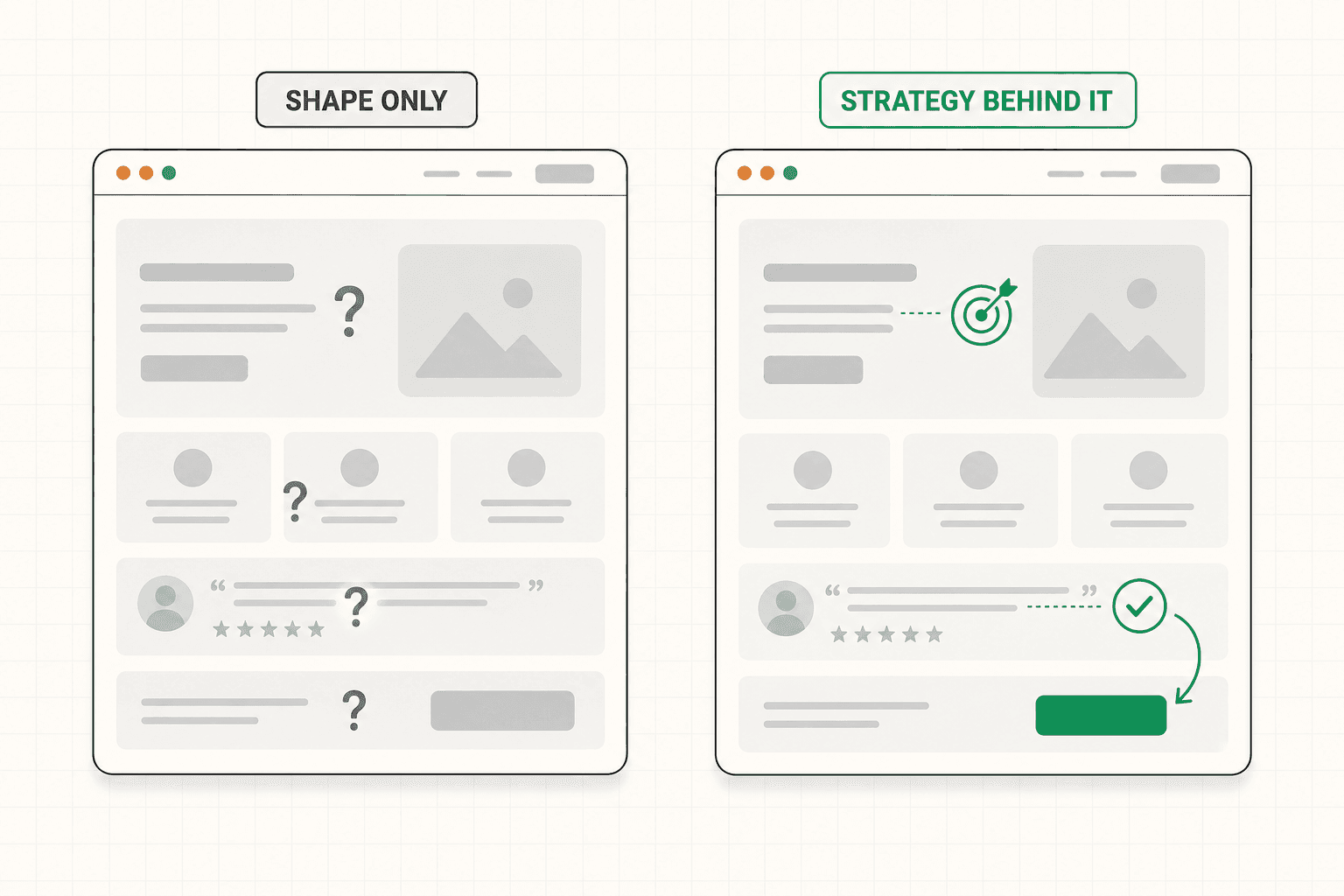
AI builders are bad at strategy. They can produce a site, but they cannot decide who the site is for, what it needs to communicate, how the argument should be structured, or what the specific buyer needs to believe before they act. They execute a structure. They do not think about whether that structure serves a commercial goal. The strategic thinking that determines whether a site converts is precisely what the AI does not do, because it is not a design or generation problem. It is a business and buyer problem.
They are bad at conversion. An AI builder will produce a hero, a features section, a testimonials block, and a CTA, because those are the components of a website. It will not know whether the hero speaks to the right buyer, whether the copy leads with outcomes or features, whether the proof is placed at the point of doubt, or whether the CTA is calibrated to visitor readiness. It produces the shape of a converting page without the thinking that makes a page convert. The gap between a page that looks right and one that converts is the core of this: Why Your Landing Page Doesn't Convert: 9 Real Reasons (And What to Fix First)
They are bad at messaging. The copy an AI builder generates is generic by nature, because it does not know your buyer, your market, your positioning, or the specific language your customers use to describe their problem. It produces plausible, competent, forgettable copy that could belong to any business in your category. The specificity that makes messaging convert is exactly what the AI cannot supply, because it does not have the customer research, the sales call insights, or the strategic positioning that specificity comes from. The role of specific, buyer-first messaging is covered here: Landing Page Copywriting: What Actually Makes It Convert
They are bad at differentiation. Because AI builders work from patterns and templates, they tend to produce sites that look like other sites built the same way. For a business trying to stand out, look premium, or signal that it is a serious player, the subtle sameness of AI-generated design can work against it. The output is competent and unremarkable, and unremarkable is a problem when the goal is to be chosen over competitors.
The Real Question Is What the Website Needs to Do
The choice between an AI builder and hiring is not really about the tools. It is about what your website actually needs to accomplish, and the honest answer varies enormously between businesses.
If the website's job is to exist, to provide basic information, to give the business a legitimate online presence without being a primary driver of revenue, an AI builder is often the right choice. Spending thousands hiring someone to build a site that does not need to do heavy commercial work is a poor allocation of budget. The AI builder gets you a competent site fast and cheap, and competent is enough for that job.
If the website's job is to convert, to turn traffic into leads or sales, to be a serious commercial asset that the business depends on for revenue, the calculation changes. The strategic thinking, the conversion architecture, the specific messaging, and the differentiation that an AI builder cannot provide are exactly what a converting site requires. For this job, the gap between an AI-generated site and a strategically built one shows up directly in the conversion rate, and the cost of hiring is easily justified by the revenue difference. The framework for whether a site is a commercial asset or just a presence is here: Website Redesign Process: What Actually Happens (And What Separates Good Rebuilds from Wasted Ones)
The mistake businesses make in both directions is misjudging which job their website has. Spending heavily to hire someone for a site that just needs to exist wastes money. Using an AI builder for a site that needs to drive serious revenue leaves money on the table in lost conversions that dwarf the savings on the build. The question to answer honestly before choosing is: how much does this website actually need to convert, and what is a few points of conversion rate worth to the business?
The Hybrid Reality
The framing of AI builder versus hiring as a binary choice is increasingly outdated, because the most effective approach for many businesses is a combination of both.
The AI tools are genuinely useful for parts of the process even when a professional is involved. They speed up the production work, handle the technical build, and reduce the time spent on the mechanical parts of creating a site. A professional who uses these tools can work faster and focus their time on the strategic and conversion work that actually matters, rather than on the production tasks the AI can handle.
This means the real question for many businesses is not "AI builder or hire someone," but "how do I get the strategic thinking my site needs, using whatever combination of tools and people gets me there efficiently." Sometimes that is a professional using AI tools to work faster. Sometimes it is starting with an AI builder and bringing in a professional for the conversion-critical pages. Sometimes it is a professional handling strategy and messaging while AI handles production.
The businesses that get the best results tend to be the ones that understand what actually drives conversion, the strategy, the messaging, the conversion architecture, and make sure that thinking happens, regardless of whether the production is done by a person, a tool, or a combination. The tool is not the point. The thinking is the point. AI has made the production cheaper and faster, which is genuinely valuable, but it has not replaced the strategic work that determines whether a site converts.
How to Decide for Your Situation
If you are deciding between an AI builder and hiring, work through these questions honestly.
How much does your website need to convert? If it is a primary revenue driver, the strategic and conversion work matters enormously and an AI builder alone will likely underdeliver. If it just needs to exist, an AI builder is probably the efficient choice.
Do you have the strategic thinking covered? If you or someone on your team can supply the buyer understanding, the messaging, and the conversion structure, an AI builder can handle the production of that thinking effectively. If that thinking is missing, the AI builder will produce a competent-looking site that does not convert, because the thinking is what it cannot do.
What is a few points of conversion rate worth to you? If your site drives significant traffic or revenue, the difference between an average-converting site and a well-converting one is often worth far more than the cost of getting the strategy right. If your site drives little revenue, that difference is negligible and the AI builder's savings win.
How important is differentiation? If you need to stand out, look premium, or signal that you are a serious player in a competitive market, the subtle sameness of AI-generated design may work against you. If differentiation is not critical, competent and unremarkable is fine.
Where are you in the business lifecycle? Early-stage validation favors the speed and cost of AI builders. An established business where the site is a core commercial asset favors the investment in getting it right.
If you are not sure whether your current site, however it was built, is actually converting the way it should, that is a diagnosable question independent of how it was made. A structured audit identifies whether the site is doing its commercial job before you decide what to do next. See how the 48h Audit works
The Short Version
AI website builders have gotten genuinely good, and dismissing them is as wrong as overselling them. They are good at producing clean, functional sites fast and cheap, which is enough for businesses whose website just needs to exist.
They are still bad at the things that make a site convert: strategy, conversion architecture, specific messaging, and differentiation. These are business and buyer problems, not generation problems, and they are exactly what determines whether a site drives revenue.
The real question is not AI builder versus hiring. It is what your website needs to do. If it just needs to exist, use an AI builder. If it needs to convert and drive real revenue, the strategic thinking matters more than the tool, and that thinking has to come from somewhere, whether that is a professional, a professional using AI tools, or a hybrid.
The tool is not the point. The thinking is the point. AI made the production cheaper. It did not replace the strategy that makes a website actually work.
Keep reading