Demo Request Page: How to Get More Qualified Demos Booked (Not Just More Clicks)

@nadolconverts
Kacper Nadol

For most B2B and SaaS companies, the demo or discovery call is the actual conversion goal, and the page driving it is rarely built well. Most demo request pages either convert too few visitors or fill the calendar with calls that go nowhere. This article breaks down how to get more qualified demos booked.
Why the Demo Request Page Is Quietly Critical
For a large share of B2B and SaaS companies, the demo or discovery call is the conversion event that actually matters. It is the point where an anonymous visitor becomes a real sales opportunity, where the pipeline gets built, where the deals that fund the business begin. And the page responsible for driving that conversion is often an afterthought.
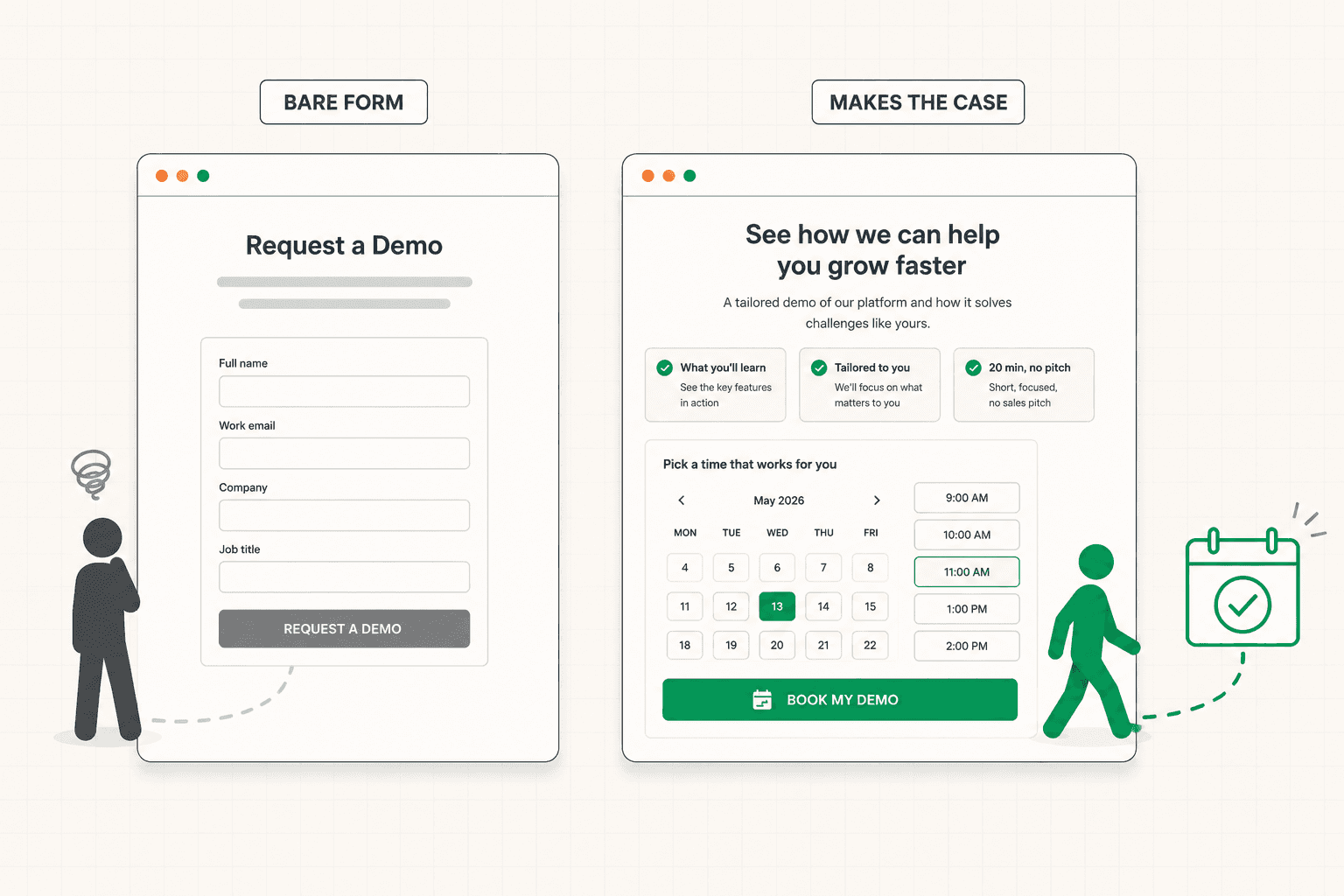
The typical demo request page is thin. A headline that says "Request a Demo," a form, maybe a line or two of generic copy, and a submit button. It is treated as a utility rather than a conversion surface, as if the visitors who reach it have already decided and just need a place to enter their details. This assumption is wrong, and it costs companies a meaningful number of demos.
The reality is that the demo request page is doing real conversion work, or failing to. A visitor who reaches it is interested but not necessarily committed. They are weighing whether a demo is worth their time, whether this is the right moment, whether they want to enter a sales process. The page either addresses those hesitations and converts them, or ignores those hesitations and loses them. Treating the demo request page as a serious conversion surface rather than a form container is one of the more overlooked opportunities in B2B conversion.
The Two Failure Modes
Demo request pages fail in two opposite directions, and the right fix depends on which one is happening.
The first failure mode is converting too few visitors. The page is not making a strong enough case for why the demo is worth the visitor's time, the form is too long or asks for too much too soon, or the page does nothing to reduce the natural hesitation around committing to a sales call. Interested visitors arrive, weigh the effort against the unclear benefit, and leave without booking.
The second failure mode is the opposite. The page converts plenty of visitors, but the demos that get booked are low quality. The sales team spends time on calls with people who were never realistic buyers, who were just curious, who do not have the budget or the need or the authority to actually purchase. The calendar is full and the pipeline is empty. This is a qualification failure disguised as conversion success.
These two failure modes require different responses. A page converting too few needs stronger persuasion and reduced friction. A page converting too many of the wrong people needs better qualification. Getting this wrong, adding qualification to a page that already converts too few, or reducing friction on a page that already attracts too many tire-kickers, makes the actual problem worse. Diagnosing which failure mode you are in is the necessary first step. The framework for balancing conversion and qualification is here: How to Qualify Leads on Your Website Without Killing Conversions
Making the Case for the Demo Itself
The most common reason demo request pages under-convert is that they assume the visitor already wants the demo, so they make no case for it.
But the visitor often does need convincing. A demo is a commitment. It means giving up time, sitting through a sales conversation, and engaging with a process they may not be ready for. The page needs to make the demo feel worth that commitment, which means communicating what the visitor will actually get from it.
The demo request pages that convert well are specific about the value of the call. They tell the visitor what the demo will cover, what they will learn, and what they will walk away with. They frame the demo around the visitor's benefit rather than the company's sales goal. "See exactly how this would work for your specific use case" is more compelling than "Request a demo." "Get a walkthrough tailored to your team's workflow and your questions answered" gives the visitor a reason to book that a bare form does not.
Reducing the perceived cost of the demo also helps. Many buyers hesitate because they imagine a long, high-pressure sales pitch. A page that signals the opposite, a focused conversation, a specific time commitment, no obligation, removes the anxiety that causes interested visitors to hesitate. "A 20-minute call focused on your situation, no hard pitch" addresses the exact fear that stops people from booking. The way CTA framing reduces commitment anxiety is covered here: Call to Action Examples: What Actually Makes a CTA Convert (Beyond Button Color)
Qualification Without Killing Conversion
For pages that attract too many unqualified bookings, the solution is qualification, but it has to be done carefully so it filters poor-fit leads without scaring off good ones.
The crudest form of qualification is a long form full of screening questions, but this kills conversion among qualified buyers too, because it adds friction for everyone. The better approach is targeted qualification that filters the wrong people while letting the right people through with minimal friction.
A single well-chosen qualification question can do significant work. Asking about company size, budget range, timeline, or the specific problem the visitor is trying to solve, framed as a natural part of preparing for the call rather than an obvious gate, helps route and filter without feeling like an interrogation. The key is asking only the questions that genuinely matter for qualification and framing them around helping the visitor get a more relevant demo rather than around screening them out.
Qualification can also happen through the messaging rather than the form. A page that is specific about who the product is for naturally filters the audience before they even reach the form. When the page clearly speaks to a particular kind of buyer with a particular kind of problem, visitors who do not fit that description often self-select out, which reduces unqualified bookings without adding any form friction at all. This kind of qualification-through-clarity is often more effective and less costly than form-based screening. The way specificity filters the audience is covered here: B2B Landing Page: What Makes It Actually Work
The Form and the Booking Experience
The mechanics of how the visitor actually books the demo have a significant effect on conversion, and small improvements here often produce outsized results.
The form should ask for what is genuinely needed to qualify and prepare for the call, and nothing more. Every unnecessary field costs conversion. Name, work email, company, and perhaps one qualification question is often enough. Fields that serve internal convenience rather than genuine need should be cut, because the conversion cost of each field is real and the data from unused fields is worthless. The full framework for form design is here: Lead Capture Form: How to Build One That Converts (And Qualifies)
The booking experience itself matters enormously. A page that lets the visitor book a specific time directly, seeing the available slots and choosing one, converts better than one that captures a request and promises follow-up later. The gap between requesting a demo and actually having it scheduled is a place where momentum dies. The visitor who has to wait for someone to email them back to arrange a time often loses interest or gets distracted before the call ever gets booked. Letting them lock in a specific time while their intent is high captures the conversion at its peak.
Reducing the steps between deciding to book and having a confirmed slot is one of the highest-leverage improvements available on a demo request page. Every additional step, every delay, every handoff is a place where a ready buyer can slip away.
Reassurance and Proof at the Booking Moment
The demo request page is a moment of commitment, and like any commitment moment, it benefits from reassurance and proof placed right where the hesitation forms.
A visitor about to book a demo is weighing whether it is worth their time and whether this company is worth engaging with. Proof placed on the demo request page addresses this directly. A testimonial from a similar buyer about how valuable the demo or the product was, a specific result a comparable company achieved, or a logo from a recognizable company in the visitor's space all reduce the hesitation at the booking moment. This is proof doing conversion work at the exact point of decision rather than decorating a page elsewhere. The principle of placing proof at the point of doubt is covered here: Social Proof: How to Use It So It Actually Converts (Not Just Decorates)
Reassurance about what happens next also helps. Telling the visitor what to expect from the demo, how long it will take, who they will be talking to, and what they will get out of it removes the uncertainty that causes last-second hesitation. The visitor who knows exactly what they are committing to is more likely to commit than the one staring at a form wondering what they are getting into.
How to Improve Your Own Demo Request Page
If you want to get more qualified demos booked, start by diagnosing which failure mode you are in.
Look at your numbers honestly. Are you converting too few of the visitors who reach the page, or are you converting plenty but booking low-quality calls? The answer determines everything about what you should fix. Too few conversions means you need stronger persuasion and less friction. Too many unqualified calls means you need better qualification, ideally through clearer messaging and a targeted question rather than a longer form.
Read your demo request page as an interested but hesitant visitor. Does it make a case for why the demo is worth your time? Does it tell you what you will get from the call? Does it reduce the fear of a high-pressure sales pitch? Or does it just present a form and assume you are ready? Each gap is a place where interested visitors are leaking.
Check the booking experience. Can the visitor book a specific time directly, or do they have to request and wait? The gap between request and confirmation is where momentum dies. Closing it often produces immediate improvement.
If you are not sure why your demo page is underperforming, a structured diagnosis identifies the specific breakdown before any changes are made. See how the 48h Audit works
The Short Version
For most B2B and SaaS companies, the demo or discovery call is the conversion goal that actually matters, and the page driving it is usually treated as a form container rather than a conversion surface.
Demo request pages fail in two opposite ways: converting too few visitors, which needs stronger persuasion and less friction, or booking too many unqualified calls, which needs better qualification. Diagnosing which one you are in comes first.
The pages that convert well make a specific case for why the demo is worth the visitor's time, reduce the anxiety around committing to a sales call, qualify through clear messaging and a targeted question rather than a long form, let the visitor book a specific time directly, and place proof and reassurance right at the booking moment.
The demo request page is where pipeline gets built. Treat it like the conversion surface it is, not like a form to be filled.
Keep reading