How to Write a Landing Page: The Process That Actually Produces a Converting Page

@nadolconverts
Kacper Nadol
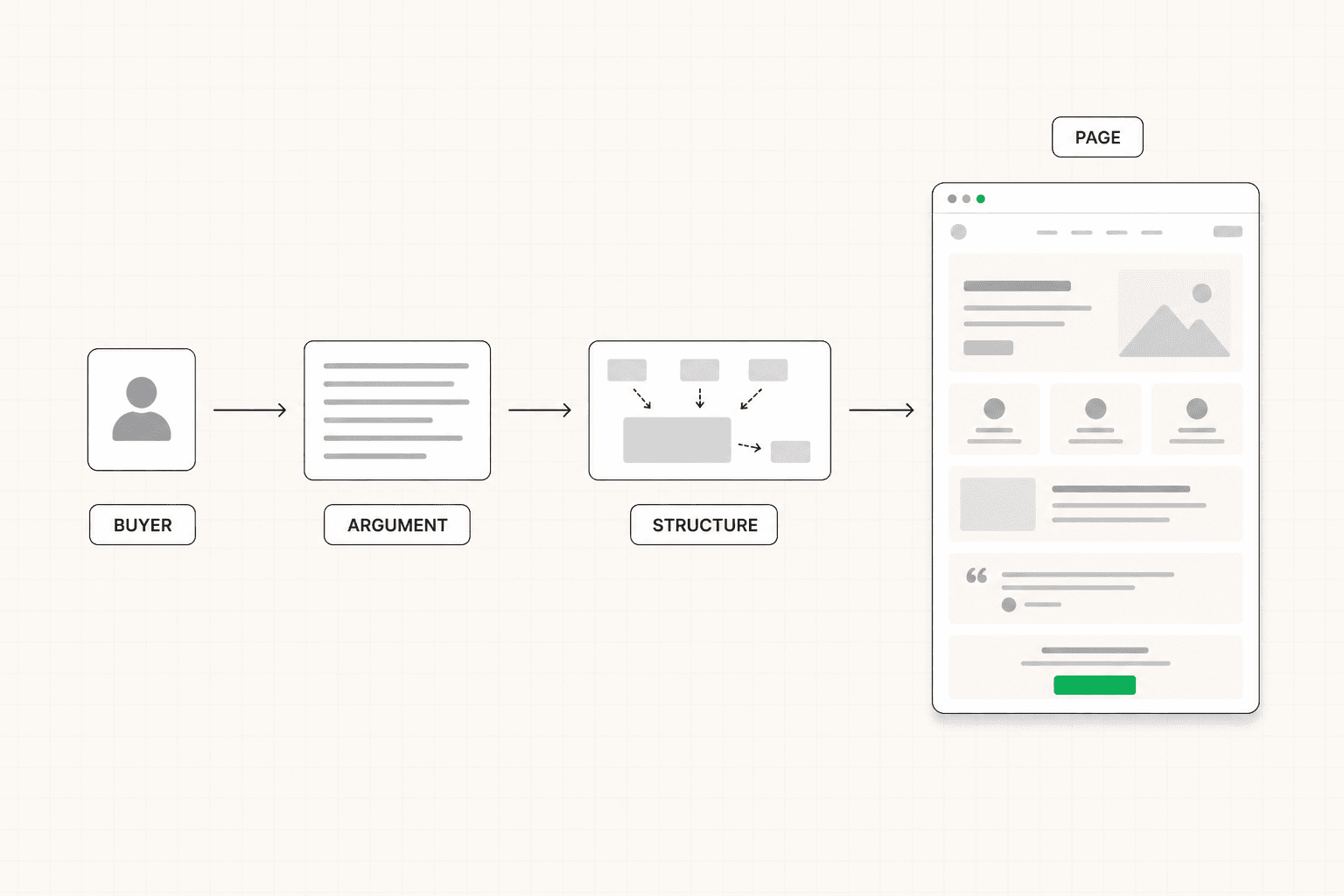
Most advice on writing a landing page focuses on individual techniques — headlines, hooks, calls to action. The harder problem is the process: how to actually go from a blank page to a converting one without producing something generic. This article walks through the sequence that works.
Why Writing a Landing Page Is Different From Other Writing
Writing a landing page is not the same problem as writing a blog post, an email, or a product description. The constraints are tighter, the stakes per word are higher, and the writer's instincts from every other kind of writing tend to produce poor results when applied here.
A blog post can afford digression, atmosphere, and pace. A landing page cannot. Every sentence either moves the reader closer to belief or moves them closer to action. Sentences that do neither should not be on the page, no matter how well written they are.
A piece of brand writing can afford to express the company's personality, history, and values. A landing page is not about the company. It is about the buyer's problem and how this specific page connects that problem to a solution worth their attention right now. Personality, history, and values get cut unless they are doing conversion work in the specific moment they appear.
A product description can afford to enumerate features at length. A landing page that does the same thing converts poorly because features are mechanism, not motivation. Buyers do not arrive at the page to learn what the product does. They arrive trying to figure out whether it solves their problem and whether they should trust this team to deliver it.
These differences sound subtle. They produce dramatically different writing once you take them seriously. The process below is built around those differences.
Step One: Get the Inputs Before You Write a Word
Most underperforming landing pages were doomed before the first sentence was written, because the writer started with the product instead of with the buyer.
Before writing anything, you need answers to a small number of questions. They are not optional. Skipping them produces a page that describes the product accurately and converts poorly.
Who is the one specific person this page is built for? Not a demographic. Not "founders" or "marketing teams." A person in a specific situation, with a specific problem, at a specific stage of awareness. The more concrete you can be, the better every subsequent decision gets made.
What problem is bringing them to this page? Not the problem in general. The specific frustration, goal, or pressure that prompted them to search for something or click a specific ad. The page should reflect what they were thinking about when they decided to visit.
What do they currently believe about the problem? What solutions have they already considered or tried? What are they skeptical about? What would actually move them from where they are now to wanting to take the next step?
What is the one action this page needs to drive? Not three options. One primary conversion goal that every part of the page is built around. Everything else is either supporting that goal or should not be there.
What are the three biggest objections a qualified buyer would have? Pricing, implementation, integration, data, trust, contract terms — whichever ones come up most often in real sales conversations. The page needs to address these directly because they are the silent reasons qualified buyers do not convert.
What proof do you have? Testimonials, case studies, specific results, named clients, measurable outcomes. List the actual content, not just the categories. Proof is one of the most undervalued inputs to a landing page and the one most likely to be underdeveloped at this stage.
The most reliable way to get these inputs is to talk to your sales team and to a handful of existing customers. The language buyers use to describe their own problems is almost always sharper and more persuasive than anything written from scratch. Mining their actual words is one of the most effective things you can do before drafting any copy. The full framework for assembling these inputs is here: How to Write a Landing Page Brief That Actually Gets You a Converting Page
Step Two: Write the Argument Before You Write the Copy
This is the step almost no one does, and it is the reason most landing pages underperform.
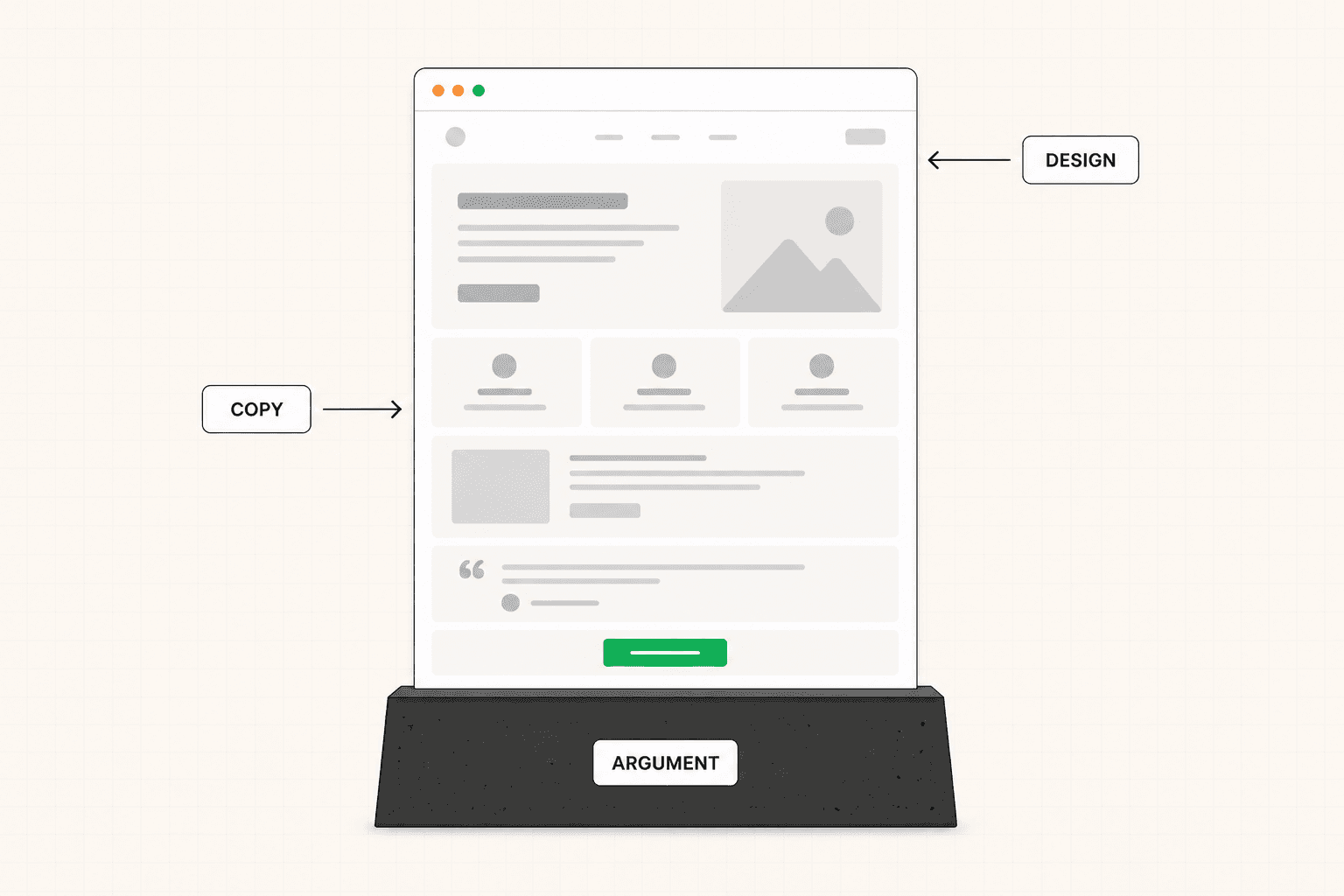
Before writing any actual sentences, write the argument the page is making. Not in marketing copy. In plain language, like you were explaining to a colleague why someone should believe this offer is worth their time.
The argument has a structure. It usually looks something like:
The person reading this page is in this specific situation. The situation is creating this specific problem. The problem has these specific costs that the reader is feeling. There is a way to solve it. This is what that way looks like. Here is evidence that this specific way works. Here are the questions that would come up before committing to it, and here are honest answers to each. Given all of that, here is what to do if you want to take the next step.
Write that argument out as prose, in your own voice, with no marketing polish. Read it back and ask whether each step actually follows from the one before it. If something feels like a leap, the page has a logical gap that no amount of copy polish will fix. Fix the argument first.
This step takes one to two hours of focused thinking. It saves days of revising copy that is built on a weak foundation. Most copy revisions that "feel off" are not copy problems. They are argument problems that the copy is trying to mask.
Step Three: Write the Headline Last, Not First
Most people start writing a landing page by trying to write the headline. This is backwards and it is the reason headlines so often end up vague, generic, or trying to do too many things at once.
The headline is the hardest single sentence on the page. It also depends on understanding everything else the page is going to say. Writing it first means writing it without the context of the argument it is supposed to introduce, which usually produces a headline that does not quite fit when the rest of the page comes together.
The better sequence is to draft the body of the page first — the problem section, the solution explanation, the proof, the objection handling, the CTA — and then write the headline once you know exactly what the page is making the case for.
When you reach the headline, generate at least fifteen to twenty options before evaluating any of them. The first three or four headlines that come to mind are almost always the most obvious versions of an obvious framing. The interesting headlines come later, when you have pushed past the easy options into specificity, tension, or angles you would not have found if you had stopped early. The full framework for what makes a strong headline is here: Landing Page Headline: How to Write One That Actually Stops the Scroll
Evaluate them against one question: if the ideal customer for this page read this headline while distracted, scrolling quickly, with twenty other tabs open, would they slow down? If the answer is yes, develop it further. If the answer is "maybe," keep writing.
Step Four: Write the Body Around the Argument
With the argument written and the inputs clear, the body of the page becomes the smaller task of finding the right words for each section.
Start with the problem section. This is usually one or two paragraphs that name the situation the buyer is in, using language that reflects how they actually describe it. Avoid abstract phrases. Be specific. The goal of this section is recognition — the reader sees their own experience reflected in the words and feels understood before they have been sold anything.
Move to the solution section. This is where you introduce what the product or service does, framed around the outcomes for the buyer rather than the capabilities of the product. Lead with what changes for them. Follow with the specific mechanism that delivers the change. Buyers care about the change. They evaluate the mechanism only after they care.
Build the proof section throughout, not in one place. Each major claim the page makes should be supported by specific evidence near where the claim appears. A testimonial about onboarding speed belongs next to the section discussing onboarding. A case study about lead quality belongs next to the section discussing lead quality. Proof at the point of doubt does conversion work. Proof grouped decoratively does not.
Weave objection handling into the relevant sections. If pricing is a known concern, address it where pricing first comes up, not in an FAQ at the bottom. If implementation complexity is a concern, address it where implementation is discussed. The objections that block conversion need to be answered before the visitor abandons the page, not stored where only converted visitors look.
Write the CTA last. Describe exactly what the visitor is doing and what happens next. "Book my 20-minute strategy call" is doing different work than "submit." The button copy is the final friction-reduction step before action. Make it specific.
Step Five: Cut Aggressively
The first draft of every landing page is too long, too padded, and full of sentences that exist because the writer was thinking out loud rather than writing for the reader.
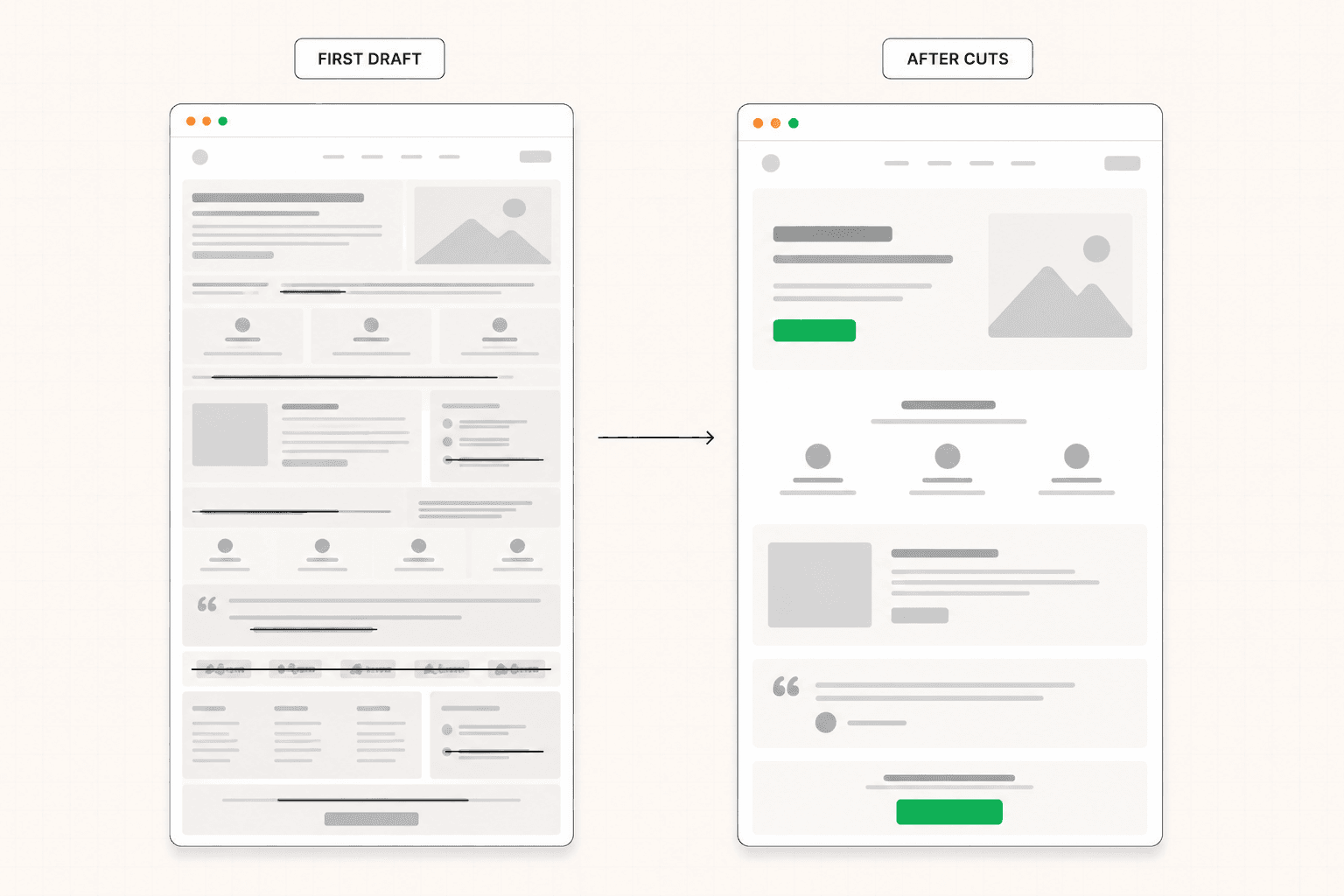
The revision pass is not a polish pass. It is a cutting pass. Read each sentence and ask one question: does this sentence move the reader closer to belief or closer to action? If the honest answer is neither, cut it. No matter how well written. No matter how much you like it. The page is not a place to admire your own writing. It is a place to convert a specific person who is currently scanning faster than you would like.
Cut paragraphs that explain things the reader already understands. Cut sentences that hedge or qualify. Cut adjectives that are not doing specific work. Cut transitions that the next sentence does not actually need. Cut anything that sounds like marketing copy in general rather than a specific case for this specific page.
A useful exercise is to remove 25% of the words from your first draft, then read it again. The page almost always feels stronger, not weaker, because the remaining words are doing more concentrated work. Density matters. The reader's attention is finite, and every wasted sentence is one fewer attention unit available for the parts of the page that actually need to land.
Step Six: Read It Out Loud
This sounds trivial. It is one of the most useful steps in the entire process.
Read the page out loud, from the top, at normal speaking pace. Note every place where you stumbled, where a sentence felt awkward, where a transition required a re-read, where the rhythm broke down. Each of those moments is a friction point for the reader, even if it is not visible in the written form.
Landing page copy should sound like a knowledgeable person talking to someone with a specific problem, not like marketing material being recited. The out-loud test reveals where the copy has slipped into marketing voice without anyone noticing. Phrases that read fine on the screen often sound stilted when spoken, because they have lost the natural rhythm of how people actually express ideas.
Rewrite the parts that did not sound right. Re-read again. Repeat until the page reads like a conversation that happens to be persuasive, not like a sales document trying to sound like a conversation.
Step Seven: Check the Page Against the Original Inputs
Before considering the page complete, return to the inputs from step one and check the page against them.
Does the hero speak to the specific buyer you wrote the page for? If you covered the company name and read just the hero, would someone in that target audience feel recognized?
Does the page address the three biggest objections you identified, in the relevant sections? Or did some of them get lost in the writing process?
Does the proof you have actually appear in the page, placed near the relevant claims? Or is it sitting in a single section at the bottom?
Is the CTA asking for something proportionate to where the realistic visitor is when they reach it? Or are you asking for a heavy commitment from someone who has been on the page for ninety seconds?
These check questions take ten minutes. They almost always surface at least one or two gaps that would otherwise ship in the final version. Fixing them before launch is cheaper than fixing them after.
What to Do If This Feels Hard
Writing a landing page well is harder than most people expect, and the difficulty is not in the writing itself. It is in the thinking that has to happen before the writing.
The teams that produce strong pages tend to share something that the teams that produce weak pages do not. They take the time to understand the buyer in concrete detail, to write out the argument before they touch any copy, to mine real customer language, and to cut ruthlessly. This is not a copywriting skill. It is a discipline that copywriting depends on.
If this discipline is missing on your team, the page is almost certainly going to underperform, no matter how good the writer is. The fix is not finding a better writer. It is investing in the upstream work that makes good writing possible. Customer research. Sales call review. A real argument before any copy. Clear inputs before any drafting.
If your current page is not converting and you suspect the underlying problem is in the messaging or the argument rather than the design, the fastest way to confirm that is a structured audit that maps the specific failure points. The audit tells you whether the issue is copy, structure, proof, friction, or something else entirely, so the rewrite that follows is targeted rather than speculative. See how the 48h Audit works
The Short Version
Writing a landing page that converts is mostly not about the writing. It is about the thinking that precedes the writing.
Get the inputs first — the buyer, the problem, the proof, the objections, the conversion goal. Write the argument before any copy, in plain language, until each step follows from the one before it. Draft the body around the argument. Write the headline last, with at least fifteen options. Cut aggressively. Read it out loud. Check the final page against the original inputs before shipping.
This sequence takes longer than just sitting down and writing. It produces a page that converts, which is the only outcome that matters.
Keep reading