Website Copywriting: What Actually Makes a Site Convert (And Where Most Copy Fails)

@nadolconverts
Kacper Nadol
Most websites have copy. Few have copy that does conversion work. The difference is not in the writing skill of the person who wrote it. It is in what the copy was built to do and how it was structured to do it. This article covers what website copywriting actually involves, where most sites get it wrong, and what changes when copy is treated as a commercial asset rather than a content task.
Why Website Copy Is a Distinct Discipline
Writing copy for a website is not the same as writing a blog post, a brochure, or an internal document. It looks similar on the surface — words arranged into sentences and sentences arranged into sections — but the constraints, goals, and reader behavior are different enough that techniques from other kinds of writing often produce poor results when applied to a website.
A website reader is not curled up with a cup of coffee reading carefully. They are scanning, skimming, and constantly evaluating whether to keep going or close the tab. They are not impressed by polished prose for its own sake. They are looking for signals that this site is for someone in their situation, that it can solve their problem, and that it is worth a few more seconds of their attention.
This changes everything about how the copy needs to be written. Short, scannable sections. Clear hierarchy. Specificity over generality. Outcomes over capabilities. Front-loaded value. The version of "good writing" that wins on a website is different from the version that wins in a magazine or a book.
The most common mistake in website copywriting is not bad writing. It is writing that is technically fine but commercially aimless. The sentences are well-constructed. The grammar is correct. The tone is professional. And the copy does no conversion work at all, because it was written to fill space rather than to move a specific reader toward a specific action.
Start with the Reader, Not the Business
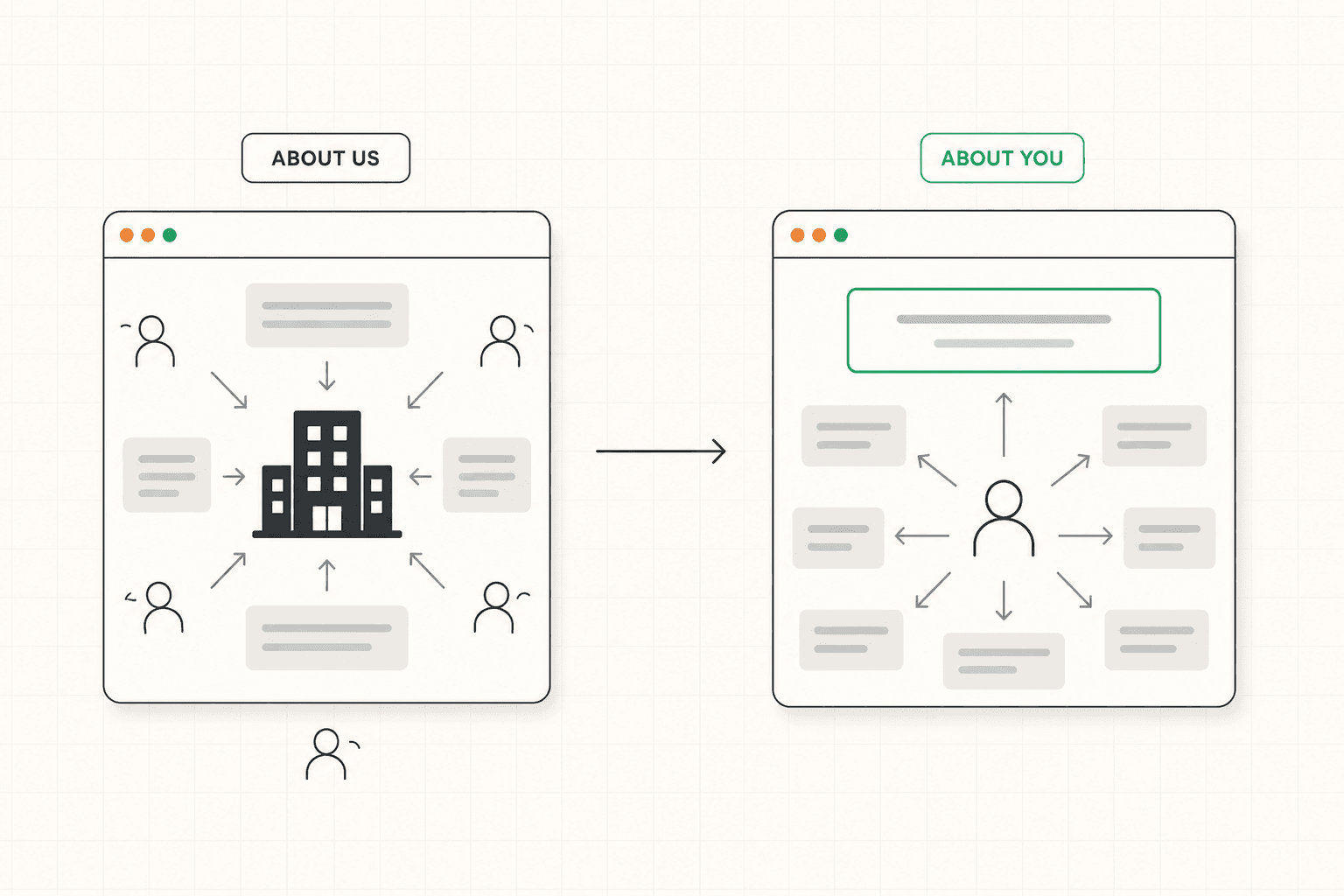
Most website copy reads as if it was written from the inside of the company looking out. "We are a leading provider of integrated solutions for modern enterprises." "Our platform empowers teams to do their best work." "Founded in 2017, we serve thousands of businesses worldwide."
This is the most common pattern in underperforming website copy and the easiest one to fix. The reader does not care about the company yet. They care about their own problem. The copy that converts starts from the reader's world and brings the company in only as a solution to that world's specific friction.
The shift is mechanical once you see it. Take any sentence that starts with "we," "our," or the company name. Rewrite it from the reader's perspective. "We help companies streamline operations" becomes "Stop spending three hours a week on reports your team will not read." "Our platform empowers teams" becomes "Your team stops working in three separate tools to do one job."
The information being communicated is roughly the same. The work being done by the sentence is completely different. One version describes the company. The other describes what changes for the reader.
This is not a writing technique. It is a worldview about whose attention the copy is competing for. The reader's attention is finite and contested. Copy written from inside the company is asking the reader to make sense of the company's perspective. Copy written from the reader's perspective is doing that work for them.
The Three Layers of Website Copy
Most websites need to do three different kinds of copy work, and confusing them produces sites that read as either too aggressive or too vague.
Layer one: hero copy and landing pages.
This is the high-intent surface. The visitor arrives with a specific question or goal and is evaluating quickly whether this site can address it. The copy here needs to be sharp, specific, and front-loaded. Every sentence is competing for the next sentence's attention. The argument needs to build fast. The full framework for what this copy needs to do is here: Landing Page Copywriting: What Actually Makes It Convert
Layer two: explanation and education pages.
Feature pages, use case pages, integration pages, methodology pages. Here the visitor has already decided to look more carefully and wants substance. The copy needs to be specific and useful, but it can also breathe more. Detail is welcome if it is connected to outcomes. This is where most sites either go too shallow (which loses serious buyers) or too dense (which loses skimmers).
Layer three: trust and context pages.
About pages, team pages, mission and values pages, the corners of the site that exist to build credibility rather than drive direct action. The copy here is doing reputation work. It needs to feel authentic rather than generic, and specific rather than platitudinous. The same about page that reads as compelling on one site and dismissable on another usually differs in concrete specifics — real numbers, real stories, real positions — versus interchangeable generalities.
Most sites treat all three layers the same way and produce copy that is either uniformly aggressive (which alienates trust-building moments) or uniformly soft (which underperforms on conversion surfaces). Knowing which layer each page is in and writing accordingly is one of the highest-leverage improvements available.

Where Most Website Copy Fails
There are specific failure modes that show up across underperforming sites regardless of industry. Knowing them is more useful than another list of "best practices."
Vague language that could apply to any competitor.
"Comprehensive solutions for modern businesses." "Seamless integration with your existing workflow." "Empower your team to do more." This kind of copy is the equivalent of background noise. It carries no information. The reader scans past it without registering anything because there is nothing specific enough to register.
The test for this failure is to take any sentence on your site and ask whether a direct competitor could put it on their site without changing a word. If the answer is yes, the sentence is not doing work specific to your business. It is occupying space.
Feature-first product descriptions.
Most product and service pages lead with what the offering does rather than what it does for the buyer. "Real-time analytics dashboard with custom reporting and integration support." Accurate, comprehensive, and commercially unhelpful. The reader does not buy real-time analytics. They buy the version of their work life where they can see what is happening without manually pulling reports.
Rewriting features as outcomes is one of the highest-impact interventions available on a website. The mechanical version is: take each feature, ask what it means for the person using it, write that answer instead. The structural version is: rebuild the section so outcomes lead and features support them as evidence.
Walls of text where there should be hierarchy.
Long paragraphs that bury the most important sentence three lines in. Section headings that are generic instead of specific. No visual rhythm to the page. The reader cannot tell what to read first or what matters most, so they read nothing.
Strong website copy has scannable hierarchy. The most important sentence in any section should be the easiest to find. Subheadings carry meaning, not just structural labels. Important sentences sit at the top of paragraphs, not buried. White space exists to direct the eye, not just to look modern.
Tone mismatch with the buyer.
A page selling to enterprise security professionals should not sound like a page selling to indie hackers. A page targeting senior B2B operators should not read like consumer marketing. Tone is doing positioning work whether the writer intends it or not. Sites that mismatch their tone to their actual buyer create a quiet credibility gap that costs conversions without being obvious.
The fix is to read the page out loud while imagining the actual target buyer hearing it. Where would they cringe? Where would they tune out? Those are tone problems, even if every individual sentence is technically fine.
What Strong Website Copy Looks Like in Practice
Across all three layers, strong website copy tends to share a few characteristics that are worth naming concretely.
It is specific where most copy is general.
Instead of "trusted by leading companies," it names which companies and what they were trying to accomplish. Instead of "fast implementation," it names how fast and what the implementation actually involves. Instead of "world-class support," it describes what support means in practical terms — response times, channels, named team members.
Specificity is the single most reliable differentiator between copy that converts and copy that does not. It signals real knowledge. It creates concrete pictures in the reader's mind. It is harder to fake than vague positivity, which is why it carries more credibility.
It connects features to outcomes systematically.
Every claim about what the product or service does is paired with what that means for the buyer. The feature is the mechanism. The outcome is the reason to care. Strong copy moves between the two seamlessly, building the case in both layers simultaneously rather than burying outcomes under feature lists.
It addresses objections inside the body.
The questions that block conversion get answered in the relevant sections of the page rather than relegated to an FAQ at the bottom that converted visitors are the only ones reading. Pricing concerns, implementation worries, scope questions, trust questions. The copy that converts has these answered visibly, in the buyer's path, before the question becomes a reason to leave.
It has clear sequencing.
Each section earns the right to be read by what came before it. The argument builds. The reader can feel themselves being moved through the information in a deliberate order, even if they cannot articulate the structure. Pages that feel random in their organization underperform pages that feel inevitable.
It is shorter than the first draft.
Strong website copy is the second or third draft, not the first. The first draft is too long, too padded, and full of sentences that exist because the writer was thinking out loud rather than writing for the reader. Cutting 25% on revision is normal. Cutting 40% sometimes produces stronger pages than the original. Density matters. Every wasted sentence is one fewer attention unit available for the parts that need to land.
The Sequence That Produces Strong Website Copy
If you are about to write or rewrite the copy on your website, here is the sequence that consistently produces better results than starting at the homepage and writing pages in order.
Start with the buyer. Get specific about who lands on the site, what they are trying to accomplish, what they already believe about their problem, and what would actually move them. The depth of this work directly predicts the quality of the copy that follows. There is no shortcut.
Then write the argument. Not in marketing copy. In plain language. What does this business actually offer, to whom, and why does it matter to that specific person? Build the case in your own voice before any polish gets added. If the argument has gaps in plain prose, no amount of writing skill will hide them in the final copy.
Then write the homepage and primary landing pages, because those carry the most conversion weight. The high-intent surfaces are where the strongest writing belongs. Spend the time getting the hero, the messaging hierarchy, and the proof architecture right before moving on.
Then write the explanation and education pages, which serve buyers who are evaluating more carefully. These can take more length but still benefit from the same discipline around outcomes, specificity, and hierarchy.
Then write the trust and context pages last. These are the easiest to write generically and the most damaging when they are. Take the time to be specific, even if the content seems incidental to conversion. Buyers do check these pages, and the wrong tone here can undo the conversion work of the higher-intent surfaces.
Throughout, read every page out loud at normal speaking pace. Note every awkward transition, every stumble, every place where the rhythm breaks. These are friction points, even if they are not visible on the screen. The full process for writing a converting page step by step is here: How to Write a Landing Page: The Process That Actually Produces a Converting Page
When the Copy Is the Problem (And When It Is Not)
Sometimes a website that is underperforming has a copy problem. Sometimes it has a structure problem disguised as a copy problem. Distinguishing between them changes what you should fix.
If the copy is vague, full of buzzwords, leads with the company rather than the buyer, and reads as interchangeable with competitors, the problem is in the copy itself. A focused rewrite can transform conversion without touching the design.
If the copy is specific and well-written but visitors are still leaving without converting, the problem is more likely structural. The argument is in the wrong order. The proof is placed decoratively rather than at the point of doubt. The CTA is mismatched to visitor readiness. A copy rewrite without addressing these structural issues will produce a beautifully written page that still underperforms.
The fastest way to know which kind of problem you have is to map the breakdown points before deciding what to fix. A diagnosis identifies whether the issue is copy, structure, proof placement, friction, or some combination, so the work that follows is targeted rather than speculative. See how the 48h Audit works
The Short Version
Website copy that converts is not measured by how well it is written. It is measured by how clearly it speaks to the right reader, how specifically it makes its case, and how systematically it removes the friction between attention and action.
The most common failures are vague language, feature-first descriptions, missing hierarchy, and tone mismatches with the actual buyer. The most reliable fixes are specificity, outcome-led structure, visible objection handling, and a deliberate sequence that builds the argument section by section.
Strong website copy starts with the reader, not the business. It is the second or third draft, not the first. And it is written with the same discipline whether the page is high-intent or low-intent, even though the surface looks different across the three layers.
The difference between a site that converts and one that does not is almost always in the copy. Everything else is scaffolding for the words to do their work.
Keep reading