Framer vs Webflow: An Honest Comparison for Choosing the Right One

@nadolconverts
Kacper Nadol

Framer and Webflow are both excellent, and most comparisons are written by people trying to sell you one of them. This is an honest breakdown of what each is genuinely better at, where each falls short, and how to actually choose based on your situation rather than the hype.
A Note on Bias Before We Start
Most Framer versus Webflow comparisons are written by someone who builds on one of them and wants you to pick theirs. That is worth knowing before you read any of them, including this one.
For transparency: I build primarily on Framer and hold the Official Framer Expert designation. That gives me deep familiarity with what Framer does well and where it frustrates, and it also gives me an obvious incentive to recommend it. I am going to try to write past that incentive, because a comparison that just concludes "use the thing I sell" is worthless to you and easy to see through.
Both of these tools are genuinely excellent. Neither is a bad choice. The honest answer to "Framer or Webflow" is that it depends on your specific situation, and there are real cases where Webflow is the better call. If this article only ever pointed toward Framer, you should distrust it. So where Webflow wins, I will say so plainly, and where the choice genuinely does not matter, I will say that too.
The goal here is to help you choose based on what you actually need, not to win you over to a platform.
What They Have in Common
Before the differences, it is worth establishing how much these two tools share, because for a large number of projects, either one would produce an excellent result.
Both are visual, no-code builders that produce real, professional websites without requiring you to write code. Both give you far more design control than template-based builders like Squarespace or Wix. Both produce fast, modern, responsive sites. Both have a CMS for managing structured content like blog posts or project pages. Both are used by serious businesses and professional designers to build sites that compete with custom-coded work.
For a straightforward marketing site, a landing page, or a content-driven site, both Framer and Webflow are more than capable, and the quality of the final result will depend far more on the person building it and the strategy behind it than on which of the two tools they used. A skilled builder produces excellent work on either. An unskilled builder produces mediocre work on either.
This matters because a lot of the energy spent agonizing over the platform choice would be better spent on the things that actually determine whether the site succeeds: the strategy, the messaging, the conversion architecture. The tool is real but secondary. The framework for what actually determines site performance is here: Website Redesign Process: What Actually Happens (And What Separates Good Rebuilds from Wasted Ones)
Where Framer Is Genuinely Better
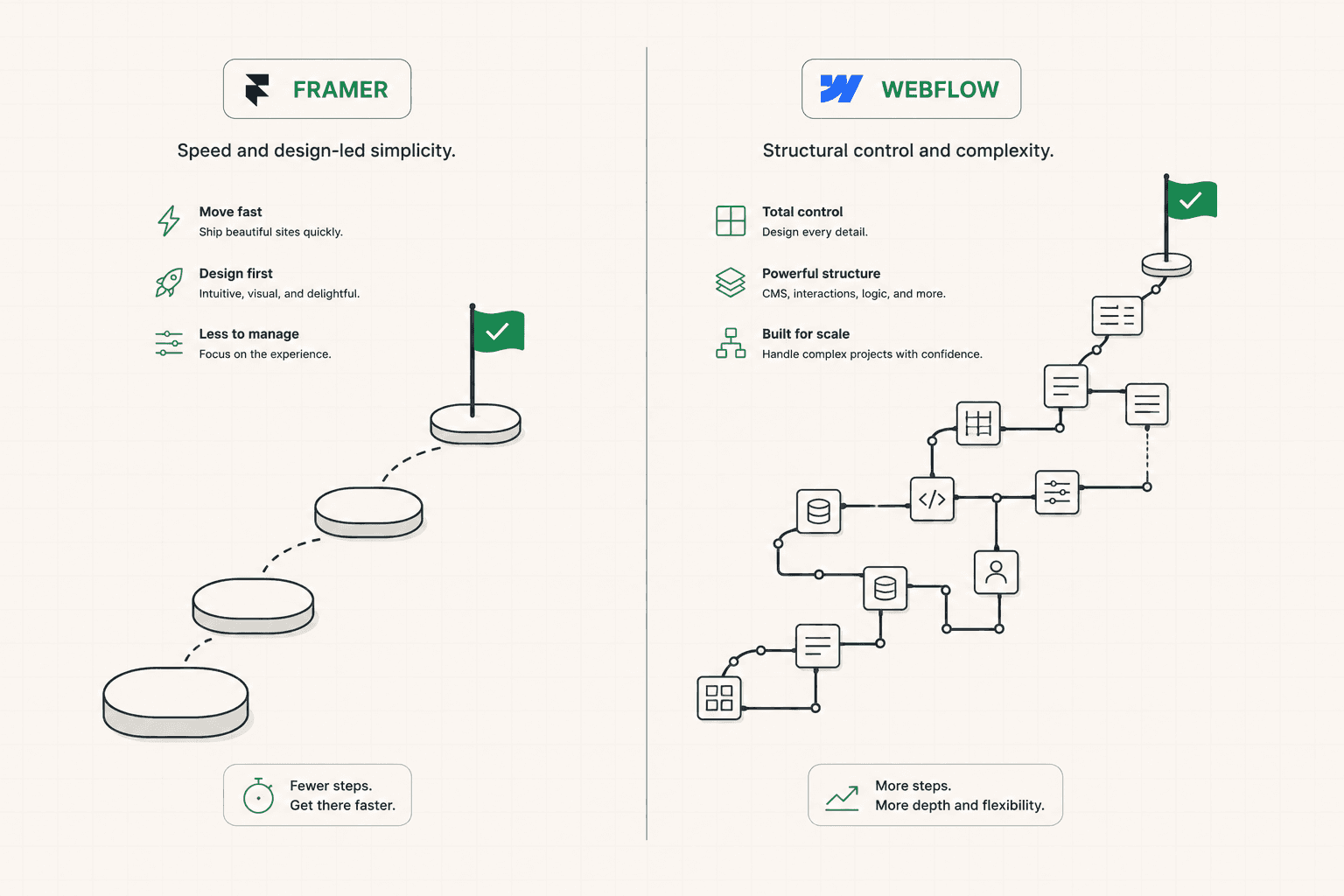
Framer's core strength is speed and ease. It is faster to learn, faster to build in, and faster to get from idea to published site.
For design-led work, Framer feels closer to designing in a tool like Figma, which makes it intuitive for designers and quick for anyone building marketing sites and landing pages. The learning curve is gentler. Someone can become productive in Framer significantly faster than in Webflow, and for solo operators, small teams, or anyone who values shipping speed, that matters.
Framer has also moved fast on modern features. Its animation and interaction capabilities are strong and easy to use. Its AI features for generating and adjusting layouts have advanced quickly. And the overall experience of building a clean, modern, well-animated marketing site is smoother in Framer than in most alternatives.
For the specific job of marketing sites, landing pages, and content-driven sites where design quality and build speed matter, Framer is often the better choice, particularly for individuals and small teams who do not have a dedicated developer and want to move quickly. It is what I build on most, and this is the honest reason: for the kind of conversion-focused marketing sites I work on, it gets to a high-quality result faster.
Where Webflow Is Genuinely Better
Webflow's core strength is structural control and depth, and for certain kinds of projects that control is genuinely worth the steeper learning curve.
Webflow gives you finer control over the underlying structure of the site. Its handling of complex, custom CMS structures with intricate relationships between content types is more powerful. For a site with a demanding content architecture, a large and complex catalog, or sophisticated dynamic content requirements, Webflow's CMS tends to handle it more robustly.
Webflow is more mature as a platform in some respects, with a longer track record, a larger ecosystem, and deeper capabilities for complex projects. Its class-based styling system, which mirrors how CSS actually works, gives developers and technically-minded builders a level of control and reusability that suits large or intricate sites, even though it makes the learning curve steeper.
For genuinely complex sites, projects with demanding content structures, or teams with the technical capability to use its depth well, Webflow is often the better choice. If the project needs the structural control, Webflow provides it, and the additional complexity is a worthwhile trade for that control. Anyone who tells you Framer is simply better across the board is not being straight with you.
The Ecommerce Question
Ecommerce is worth addressing separately, because it is an area where the comparison is more nuanced and where, for serious stores, neither may be the right answer.
Both Framer and Webflow have ecommerce capabilities, and both have improved them over time. For a small store with a modest catalog and straightforward needs, either can work, and the choice comes down to the same design-versus-control tradeoff as the rest of the comparison.
But for serious ecommerce, a store where the shopping experience, the catalog complexity, the inventory management, and the checkout optimization are central to the business, a dedicated ecommerce platform like Shopify often makes more sense than either Framer or Webflow. The specialized ecommerce platforms have deeper functionality built specifically for selling, and for a store where ecommerce is the whole business rather than one part of a marketing site, that specialization matters.
The honest guidance here is that if ecommerce is a core, complex part of your business, you should be comparing Framer and Webflow against Shopify and other dedicated platforms, not just against each other. If ecommerce is a lightweight addition to a marketing-focused site, either Framer or Webflow can handle it. The framework for what serious ecommerce conversion requires is here: Ecommerce Conversion Rate Optimization: What Actually Moves Revenue
How to Actually Choose
Rather than declaring a winner, here is how to decide based on your specific situation.
Choose Framer if you are building a marketing site, landing pages, or a content-driven site, if design quality and build speed matter to you, if you or your team value a gentler learning curve, and if you do not have highly complex structural requirements. This covers a large share of business websites, which is part of why Framer has grown so quickly.
Choose Webflow if you have a complex site with demanding content architecture, if you need fine structural control, if you have the technical capability to use its depth, or if you are already invested in the Webflow ecosystem and it is serving you well. The steeper learning curve is worth it when the project genuinely needs the control.
Consider a dedicated platform like Shopify if ecommerce is a central, complex part of your business rather than a light addition to a marketing site.
And if you are choosing between Framer and Webflow for a standard marketing site and cannot decide, the honest truth is that it probably does not matter as much as you think. Both will produce an excellent result in capable hands. Spend the energy you would have spent agonizing over the platform on the strategy, messaging, and conversion architecture instead, because those will determine whether the site succeeds far more than the choice between two excellent tools.
I build on Framer, and for the conversion-focused marketing work I do, I think it is the better fit for most of my clients. But if a project genuinely called for Webflow's depth, that is what I would recommend, because recommending the wrong tool to win a point helps nobody.
One Thing That Matters More Than the Platform
Whichever you choose, the platform does not make the site convert. This is the point that gets lost in every platform comparison, and it is the one that actually matters.
A site built on Framer or Webflow will convert well or poorly based on the strategy behind it, not the tool it was built with. The clarity of the messaging, the structure of the argument, the placement of proof, the calibration of the CTA, the resolution of objections. These determine conversion, and they are identical concerns regardless of which builder produced the page. A beautifully built Webflow site with vague messaging converts worse than a plainer Framer site with sharp messaging, and vice versa.
This is worth holding onto because the platform choice can become a distraction, a decision that feels important and productive while the decisions that actually determine success go unmade. Pick the tool that fits your situation, then put your real energy into the thinking that makes the site work. The framework for what actually drives conversion is here: Why Your Landing Page Doesn't Convert: 9 Real Reasons (And What to Fix First)
If you have a site on either platform that is not converting the way it should, that is a strategy and diagnosis question independent of the tool it was built with. A structured audit identifies what is actually holding the site back. See how the 48h Audit works
The Short Version
Framer and Webflow are both excellent, and most comparisons are biased toward whichever one the author sells. For full transparency, I build on Framer, so weigh this accordingly, though I have tried to write past that.
They share a great deal, and for many projects either would produce an excellent result. Framer is genuinely better for speed, ease, and design-led marketing sites, which is why it suits solo operators and small teams especially well. Webflow is genuinely better for structural control, complex content architecture, and sites that need its depth. For serious ecommerce, both should be compared against dedicated platforms like Shopify rather than just each other.
Choose based on your situation, not the hype. And remember that whichever you pick, the platform does not make the site convert. The strategy does. Spend your energy there.
Keep reading