Page Speed and Conversion: How Much Slow Is Actually Costing You

@nadolconverts
Kacper Nadol

Every article on this blog eventually mentions page speed in passing, because it affects everything downstream of it. This one covers the actual mechanics: how much speed matters, where the time usually goes, and what to fix first.
The Cost You Cannot See in Your Conversion Rate
Page speed has a strange property compared to most conversion problems on this blog. A vague headline loses visitors who see the page and decide it is not for them. A confusing checkout loses visitors who engage and then hit friction. A slow page loses visitors before any of that happens, sometimes before they see a single pixel of content, and those visitors never show up in most of the analysis teams do about why a page is not converting.
This is what makes speed easy to underinvest in. It does not show up as a specific section performing badly or a specific piece of copy failing to land. It shows up as a smaller number of people even reaching the point where any of your other work has a chance to matter. A page can have a sharp headline, a strong argument, and a calibrated CTA, and still convert poorly if a meaningful share of visitors never wait long enough to see any of it.
The honest starting point is that speed is not a nice-to-have layered on top of everything else discussed on this blog. It is closer to a precondition. Every other conversion improvement is only reaching the visitors who stuck around long enough to experience it.
How Much a Second Actually Costs
The relationship between load time and conversion is not gradual. It is closer to a threshold effect, where each additional second past a certain point costs a disproportionate share of visitors rather than a steady, predictable decline.
Research across large sets of sites has consistently found that conversion rates drop sharply as load time crosses roughly the two to three second mark, and continue dropping steeply from there. A page that loads in one second and a page that loads in three seconds are not separated by a small, linear difference. The gap in how many visitors stick around is often large enough to be the single biggest lever available on an underperforming page, larger than most copy or design changes by themselves.
This matters most on mobile, where connections are frequently slower and visitors are demonstrably less patient, and it matters most for visitors arriving from paid traffic, who have the least existing investment in your specific page and the lowest threshold for abandoning it. A visitor who typed your brand name into Google and is looking for you specifically will wait longer than a visitor who clicked an ad for a product they are still deciding whether they even want. The way mobile amplifies every other kind of friction, speed included, is covered here: Mobile Conversion Optimization: Why Most Sites Lose Sales on Phones
Where the Time Actually Goes
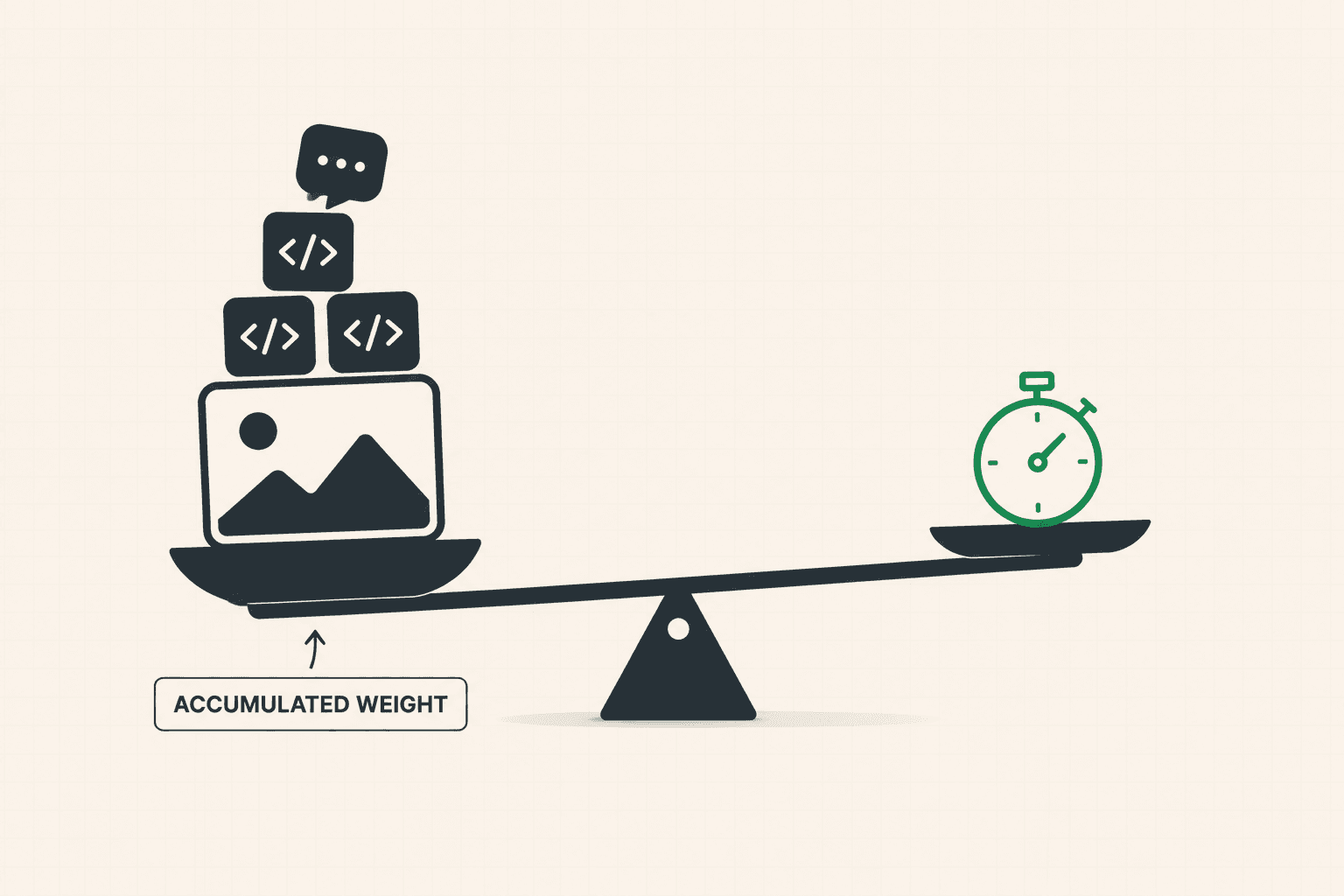
Most slow pages are not slow because of one dramatic problem. They are slow because of an accumulation of smaller ones, each individually reasonable, that add up to a page that takes far longer to become usable than anyone intended.
Images are usually the largest single contributor. A product photo or hero image exported at full resolution and uploaded without compression can be many times larger than it needs to be for how it actually displays on screen, and image weight alone is frequently the difference between a page that loads quickly and one that does not. This is compounded on pages with multiple images, galleries, or background visuals, where the effect stacks.
Third-party scripts are the second major contributor, and they are easy to lose track of over time. Analytics tools, chat widgets, tracking pixels, review platforms, and marketing tools each add a script that has to load and execute before the page is fully interactive. Most sites accumulate these gradually, adding a new tool here and there for a specific purpose, and rarely go back to audit whether everything installed is still in active use. A site that has tried five different chat tools over two years and only removed three of them is still paying the loading cost of all five.
Fonts, unnecessary animations, unoptimized code, and server response time all contribute as well, though usually to a smaller degree than images and scripts for most marketing and ecommerce sites. The pattern worth internalizing is that speed problems are rarely one big issue. They are usually several small ones that nobody has looked at together.
Perceived Speed Is Not the Same as Actual Speed
A page can technically finish loading everything in the background and still feel slow to a visitor, because what matters for conversion is not the total load time in isolation but how quickly the visitor perceives something meaningful happening.
A page that shows the headline and hero content almost immediately, even while images further down the page are still loading, feels fast, because the visitor has something to read and engage with right away. A page that shows a blank screen until every element has fully loaded feels slow, even if the total time is similar, because the visitor experienced nothing but waiting for the entire duration.
This is why the sequence in which content becomes visible matters as much as the raw total load time. Prioritizing the visible, above-the-fold content, the headline, the hero, the primary CTA, so it appears first and fast, while allowing less critical content further down the page to load slightly after, produces a page that feels dramatically faster than one where everything loads at the same uniform, slower pace. This connects directly to why the first screen carries so much weight on any page: it is not just the most important content strategically, it is also the content most worth prioritizing technically. The full framework for what belongs in that first screen is here: Landing Page Hero: What Actually Goes Above the Fold (And Why Most Get It Wrong)
Speed and SEO Are the Same Fight
Page speed is not purely a conversion issue. It is also a well-established ranking factor, which means the same technical work that improves conversion also directly supports the organic search performance a site depends on for traffic in the first place.
This creates a useful alignment that is worth being clear-eyed about. Speed is one of the rare improvements that helps both ends of the funnel simultaneously: it helps a page rank well enough to earn traffic, and it helps that traffic convert once it arrives. A site that neglects speed is quietly working against itself twice, losing some visitors before they ever find the page through search, and losing more of the ones who do find it before the page finishes loading. The way search intent and conversion intent reinforce each other more broadly is covered here: Landing Pages and SEO: Do They Actually Work Against Each Other?
What to Fix First
Given that most sites accumulate speed problems gradually rather than having one obvious cause, the practical approach is to work through the highest-leverage fixes in order rather than trying to solve everything at once.
Start with images, since they are usually the largest single contributor and the easiest to fix without touching anything structural. Compressing images properly, using modern formats that maintain quality at a fraction of the file size, and serving appropriately sized images rather than a single oversized version scaled down by the browser, together often produce the single largest speed improvement available on most sites, with essentially no downside.
Then audit installed scripts and tools. Go through everything currently loading on the site, chat widgets, tracking pixels, review platforms, marketing tools, and remove anything not in active, current use. This is unglamorous work and it is frequently one of the fastest wins available, because most sites are carrying scripts from tools nobody remembers deciding to keep.
Then look at what loads first. Confirm that the above-the-fold content, the part visitors actually see and evaluate immediately, is prioritized to appear quickly, even if elements further down the page take slightly longer.
And check the mobile experience specifically, since mobile connections are typically slower and the tolerance for waiting is typically lower, which means a site that performs acceptably on a fast office connection can still be losing a meaningful share of its actual traffic.
If your site feels slow and you are not sure what specifically is causing it, a structured diagnosis identifies the actual sources of the delay rather than guessing. See how the 48h Audit works
The Short Version
Page speed loses visitors before any of your other conversion work gets a chance to matter, which makes it one of the more invisible and more expensive problems a site can have. The relationship between load time and conversion is closer to a threshold than a gradual slope, and every second past roughly two to three seconds costs disproportionately.
Most slow pages are not slow because of one dramatic issue. Uncompressed images and unused third-party scripts are the two most common culprits, and both are usually fixable without any structural change to the site. What loads first matters as much as total load time, since a page that shows meaningful content quickly feels fast even while less critical elements are still loading behind it. And speed helps twice, since it supports both organic ranking and the conversion rate of whatever traffic that ranking brings in.
Fix images first, then audit scripts, then check what loads first, then check mobile specifically. This is unglamorous work, and it is some of the highest-leverage work available on most underperforming sites.
Keep reading