About Page: How to Write One That Actually Builds Trust

@nadolconverts
Kacper Nadol

The about page is one of the most visited pages on most sites and one of the most neglected, usually reduced to a company timeline or a founder headshot with no real thought behind either. This article covers what an about page needs to do and why most of them do almost nothing.
A Page That Gets Real Traffic and No Real Thought
The about page is consistently one of the most visited pages on a website, often second or third after the homepage, and it is also one of the pages teams spend the least time on. It gets written once, usually in a rush near the end of a website project, filled with a founding story, a mission statement, and a team photo, and then left untouched for years.
This is a strange mismatch. A page that visitors actively seek out, often deliberately clicking to it because they want to know who they might be doing business with, is treated as an afterthought compared to the homepage or the pricing page, which get real strategic attention. But a visitor who clicks through to the about page is doing real evaluative work at that moment, and a page that gives them nothing useful in return is wasting a visit from someone who was actively trying to build trust in your business.
Why Visitors Actually Click Here
Understanding what the about page is actually for starts with understanding why a visitor bothers to click on it in the first place, since almost nobody arrives at a website specifically looking for an about page. They click it from somewhere else, usually because something earlier in their experience raised a question this page might answer.
The most common reason is verification. The visitor has been reading the homepage or a service page and is now asking a version of "is this a real, legitimate business, or is this too good to be true." The about page is where they go looking for evidence one way or the other.
The second common reason is personal evaluation, particularly for service businesses, agencies, and consultants, where the visitor is not just evaluating a product but a person or a small team they might work closely with. They want a sense of who is actually behind the business before they commit any further attention to it.
The third is simple curiosity that, if satisfied well, deepens trust, and if left unsatisfied, does nothing either way. A visitor who was already fairly convinced by the rest of the site is not going to be talked out of converting by a weak about page, but they might be pushed further toward conviction by a strong one, particularly for higher-consideration purchases and service relationships where the person behind the business genuinely matters to the decision. The way trust in the people involved matters more for service businesses specifically is covered here: Service Page: How to Write One That Turns Visitors Into Booked Calls
The Generic Version Fails for a Specific Reason
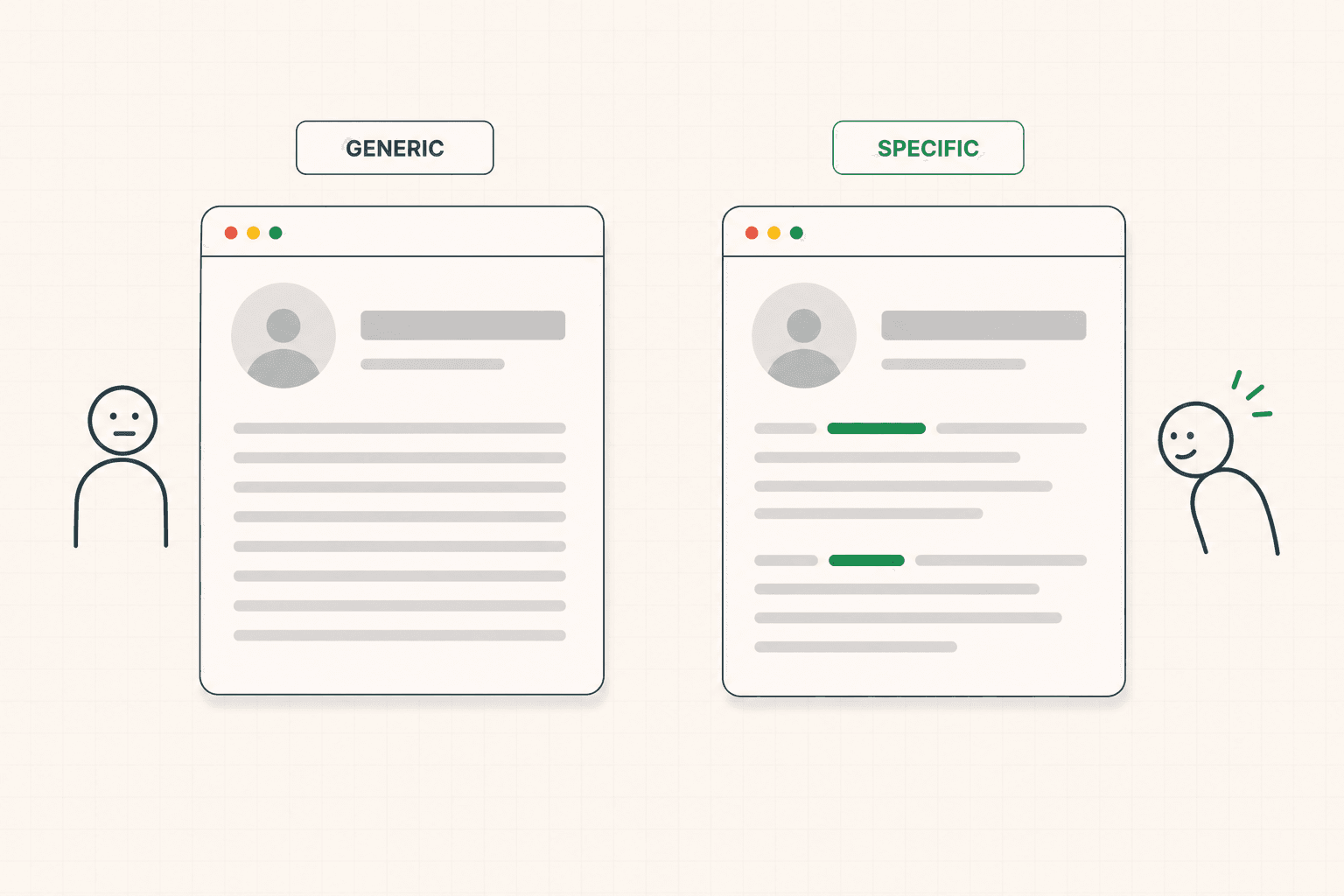
Most about pages follow the same predictable pattern: a founding story told in chronological order, a mission statement full of abstract language about values, and a team section with headshots and job titles. This pattern fails not because any individual piece of it is wrong, but because none of it is written from the visitor's actual reason for being there.
A visitor checking whether this is a legitimate, trustworthy business does not need a chronological history of the company's founding. They need specific, verifiable signals: real names, real credentials, real results, real specificity about who is actually behind the work. A visitor evaluating whether they want to work with this specific person or team does not need an abstract mission statement about "innovation" and "excellence." They need a genuine sense of who this person is and why they do this particular work.
The generic version optimizes for sounding professional rather than for actually answering the question the visitor came here with. It reads as safe and forgettable, which for most other pages might be a mild problem, but on a page specifically visited to build trust, forgettable is close to a failure, since the visitor leaves having gained nothing they did not already have before clicking. The same shift from generic to specific runs through almost everything on this blog: Website Copywriting: What Actually Makes a Site Convert (And Where Most Copy Fails)
Lead With Why, Not When
Most about pages start with a founding date and walk forward chronologically. This structure serves the company's internal sense of its own history far better than it serves a visitor trying to quickly decide whether this business understands their situation.
A stronger structure leads with why the business exists and who it exists for, before getting into any history. What problem does this business actually solve, and why did the founder or team decide it was worth solving. This can be established in a few sentences, and it immediately gives the visitor something to evaluate their own situation against, in the same way a specific value proposition does anywhere else on a site. The full framework for articulating this clearly is here: Value Proposition: How to Write One That Actually Makes People Buy
History and background still have a place, and for some businesses a genuine founding story is a real trust asset, particularly when it explains a real, specific frustration that led directly to the business existing. But it belongs after the visitor understands why any of it matters to them, not as the opening move. A chronological structure asks the visitor to sit through the company's own story before getting to anything relevant to their decision. A why-first structure respects that the visitor's time and attention are limited and gives them the relevant part immediately.
Specificity Is What Makes It Credible
The same principle that makes a headline or a case study convincing applies directly here: specific, concrete details are believable in a way that broad, positive claims are not, and this matters more on an about page than almost anywhere else, since the entire purpose of the page is building trust.
"We are passionate about helping businesses succeed" is a sentence that could appear on any about page in any industry, and a visitor reads it and learns nothing, because it carries no specific information they could not have assumed already. "I spent four years running paid campaigns for ecommerce brands before realizing most of the wasted spend was never the ads, it was the landing pages nobody had touched since launch" is specific, memorable, and gives the visitor real information about the person's actual background and actual point of view.
The same applies to results, credentials, and team information. Vague claims about experience or expertise ask the visitor to simply trust the assertion. Specific numbers, named clients where appropriate, concrete past work, and real credentials give the visitor something they can actually evaluate rather than just accept on faith. This is the same underlying mechanism that makes a specific testimonial more convincing than a vague one, applied to how a business describes itself rather than how a client describes the business. The full framework for why specificity converts where vagueness does not is covered here: Social Proof: How to Use It So It Actually Converts (Not Just Decorates)
For Solo Operators and Small Teams, This Page Matters More
For a large company, the about page is doing modest work, since the visitor is primarily evaluating the business as an institution rather than the specific individuals within it. For a solo operator, a freelancer, or a small team, the about page is often doing some of the heaviest trust-building work on the entire site, because the visitor is essentially deciding whether they trust this specific person.
This means the temptation to write the about page in a distant, corporate voice, the same instinct that produces "we believe" and "our team is dedicated to," works directly against a small business's actual advantage. A visitor considering a small agency or an independent consultant is often specifically looking for the personal element that a larger company cannot offer, and an about page that hides the actual person behind generic, corporate-sounding language throws away exactly the thing the visitor came looking for.
The honest, slightly uncomfortable version of this page, written by an actual person in their actual voice, admitting real specifics about how they got here and what they are actually good at, tends to build far more trust for a small operation than a polished, impersonal version that could have been written about any similar business. This only works if it is genuine rather than performed, which is a distinction visitors are often better at detecting than businesses expect. It is a theme that comes up often in the newsletter, usually while looking at a real about page that either nailed this or clearly did not.
Give the Page Somewhere to Go
An about page that ends without any next step wastes a visitor who arrived actively evaluating whether to trust the business further. The visitor read the page because they were doing real decision-making work, and a page that answers their trust question and then simply ends misses the moment to point them toward whatever the natural next step actually is.
This does not need to be an aggressive sales push, and given that the about page often reaches visitors earlier in their consideration than a landing page does, a heavy CTA usually feels mismatched to where they actually are. A clear, low-friction next step, a link to see real work, a way to start a conversation, or a path to the specific service or product most relevant to what they were reading, gives a visitor who is now more convinced somewhere useful to go, rather than leaving them to find their own way back into the site. The full framework for calibrating an ask to where a visitor actually is is here: Call to Action Examples: What Actually Makes a CTA Convert (Beyond Button Color)
How to Improve Your Own About Page
Read your current about page and ask honestly whether a visitor would learn anything specific from it, or whether every sentence could apply equally well to a dozen other similar businesses.
Check the structure. Does the page lead with why the business exists and who it is for, or does it open with a founding date and a chronological history that asks the visitor to wait before reaching anything relevant to them.
Look for specificity. Are the claims about experience, results, and background concrete and verifiable, or are they broad and unfalsifiable in a way that asks the visitor to simply trust the assertion.
If you are a solo operator or a small team, check whether the page actually sounds like a real person, or whether it has been written in a distant, corporate voice that erases the exact personal element visitors are often specifically looking for.
And check what happens at the end of the page. Does it point the visitor somewhere useful, or does it simply stop.
If you are not sure whether your about page is doing real work or just occupying space, a structured audit looks at this alongside the rest of the site. See how the 48h Audit works
The Short Version
The about page gets real, deliberate traffic from visitors doing genuine evaluative work, and it is one of the most neglected pages on most sites as a result of being treated as a formality rather than a real opportunity.
Visitors click here to verify legitimacy, evaluate the people behind the business, or satisfy curiosity that, handled well, deepens their trust. A generic page, full of abstract mission language and a chronological company history, answers none of these questions and leaves the visitor with nothing new. Lead with why the business exists rather than when it started. Use specific, concrete details rather than broad claims, since specificity is what makes any of it credible. For solo operators and small teams especially, let the page sound like an actual person, since the personal element is often the exact thing a visitor is looking for and a large competitor cannot offer. And give the page somewhere to send a visitor who just became more convinced.
Keep reading