Value Proposition: How to Write One That Actually Makes People Buy

@nadolconverts
Kacper Nadol
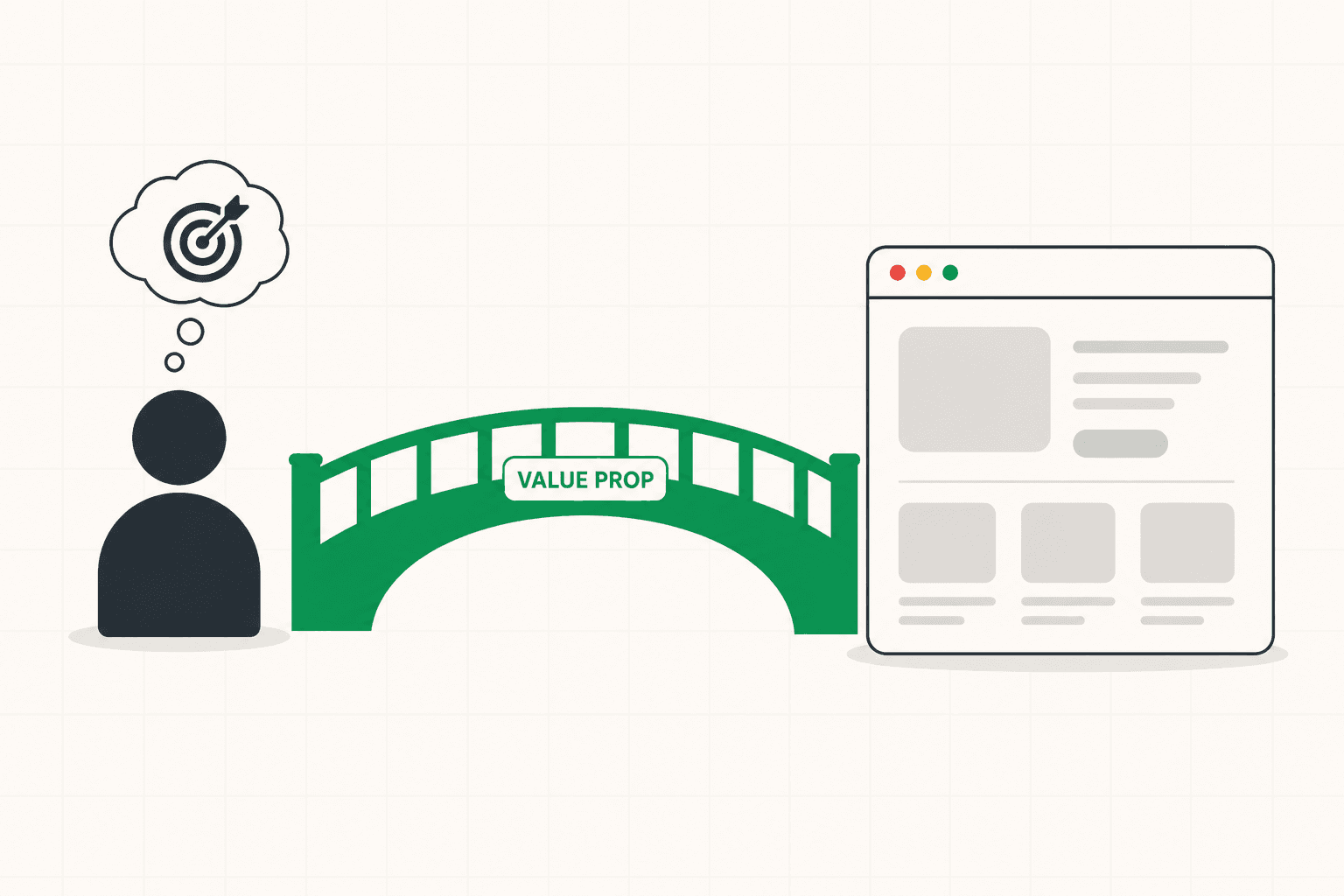
Most value propositions are vague, interchangeable, and built around what the company thinks is impressive rather than what the buyer actually cares about. This article breaks down what a value proposition really is, where most of them fail, and how to write one that does the job it is supposed to do.
What a Value Proposition Actually Is
A value proposition is the answer to a single question the buyer is asking the moment they encounter your business: why should I choose this over the alternatives, including doing nothing?
That is the whole job. Not to describe the company. Not to list features. Not to sound impressive. To answer, clearly and specifically, why this is the right choice for a particular person with a particular problem.
Most value propositions fail because they answer a different question than the one the buyer is asking. The buyer is asking "what is in this for me, and why this one?" The company answers "here is what we do and why we think we are good at it." These are not the same question, and the gap between them is where most value propositions lose the people they are supposed to convert.
A value proposition is also not a slogan, a tagline, or a mission statement. A slogan is built for memorability. A mission statement is built for internal alignment. A value proposition is built for conversion. It exists to make a specific buyer understand, quickly, why this solves their problem better than the other options they are weighing. When companies confuse these, they end up with a value proposition that sounds nice and persuades no one.
Why Most Value Propositions Fail
There are a few failure modes that show up across almost every weak value proposition, regardless of industry.
It describes the company instead of the buyer's outcome.
"We are a leading provider of cloud-based solutions for modern enterprises." This describes the company. It tells the buyer nothing about what changes for them. The buyer does not care that you are a leading provider. They care about whether their specific problem gets solved.
It is generic enough to belong to any competitor.
"Powerful, intuitive, and built for teams of all sizes." A competitor could put this on their site without changing a word. When a value proposition could belong to anyone in the category, it belongs to no one. It carries no differentiating information, so it does no conversion work.
It leads with features instead of value.
"Real-time analytics, custom dashboards, and seamless integrations." This is a feature list, not a value proposition. Features are the mechanism. Value is what the mechanism produces for the buyer. A buyer does not wake up wanting real-time analytics. They wake up wanting to know what is happening in their business without spending an afternoon building reports.
It is vague where it needs to be specific.
"Save time and money while growing your business." Every business wants to save time and money and grow. The statement is true and useless because it is not specific to anything. How much time? Saved how? Growing in what way? Specificity is what separates a value proposition that persuades from one that produces a shrug.
It tries to appeal to everyone.
In the effort to not exclude anyone, the value proposition becomes so broad that it resonates with no one. A value proposition that speaks to "businesses of all sizes across every industry" is weaker than one that speaks precisely to a specific buyer, because precision creates the recognition that drives conversion. This is the same dynamic we covered in detail here: B2B Landing Page: What Makes It Actually Work
The Components of a Strong Value Proposition
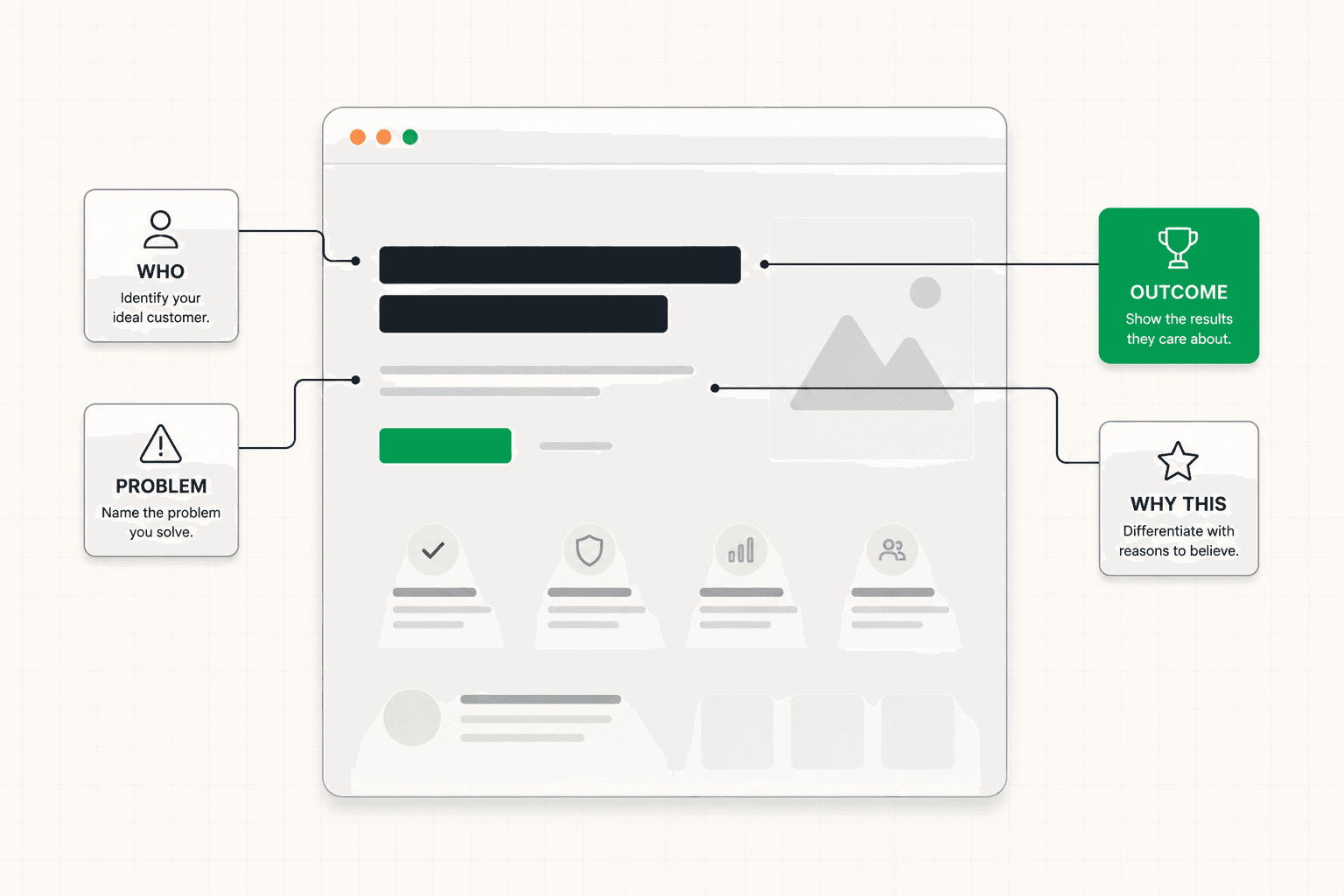
A complete value proposition usually answers four things, even if it does not state all of them explicitly in a single sentence.
Who it is for. The specific buyer the value is built around. The more precise this is, the more the right person feels recognized and the more the value lands.
What problem it solves. The specific frustration, goal, or pressure the buyer is dealing with. Named in language the buyer would use, not in abstract marketing terms.
What outcome it delivers. What actually changes for the buyer. The concrete result, stated specifically rather than vaguely.
Why this over the alternatives. What makes this the right choice compared to the other options the buyer is considering, including the option of doing nothing.
Not every value proposition states all four explicitly in one line. But the strongest ones have clearly thought through all four, and the answers show up across the hero section, the subheadline, and the supporting copy. When one of these is missing or vague, the value proposition has a gap that costs conversions.
How to Actually Write One
The process for writing a strong value proposition is less about wordsmithing and more about getting the inputs right before you write anything.
Start with the buyer, in specific terms.
Before writing a word, get precise about who this is for. Not "small businesses." A specific buyer in a specific situation. The marketing manager at a 50-person B2B SaaS company who is spending too much on ads that convert poorly. The agency owner with eight employees who keeps losing deals to bigger firms that look more established. The more specific the buyer, the sharper the value proposition.
Identify the problem in the buyer's own words.
The language the buyer uses to describe their own problem is almost always more persuasive than anything you would write from scratch. Mine it from sales calls, customer interviews, support tickets, and reviews. When the value proposition reflects the exact words the buyer uses internally, it creates an immediate sense of recognition that no amount of clever copywriting can replicate.
Name the specific outcome, not the vague benefit.
"Save time" is vague. "Get your Monday morning report without touching a spreadsheet" is specific. "Grow your business" is vague. "Turn more of your existing traffic into booked calls without increasing ad spend" is specific. Specificity is the single most reliable upgrade you can make to a value proposition. It signals real understanding and creates a concrete picture in the buyer's mind.
Articulate the differentiation honestly.
Why this over the alternatives? The answer should be true and specific. If the honest differentiator is "we do this one thing better than the generalists," say that. If it is "we are built specifically for this niche while the competitors serve everyone," say that. A specific, honest differentiator is more persuasive than a grand claim the buyer will not believe.
Write it many ways before settling.
The first version of a value proposition is almost never the best one. Write it ten or fifteen different ways. Vary which component you lead with. Try leading with the problem, then with the outcome, then with the differentiator. The strongest version usually emerges from this exploration rather than from the first attempt. This is the same discipline that produces strong headlines: Landing Page Headline: How to Write One That Actually Stops the Scroll
Where the Value Proposition Lives on Your Site
A value proposition is not a single sentence that sits in one place. It is an idea that gets expressed across several elements, primarily in the hero section of the page.
The headline usually carries the core of it: the outcome or the problem, stated specifically. The subheadline adds the supporting detail: who it is for, how it works, or what makes it different. The supporting copy and proof reinforce it throughout the rest of the page. When these elements are aligned around a single clear value proposition, the page has a through-line that builds conviction. When they are misaligned or each expressing a different idea, the page feels scattered and the value never quite lands.
This is why the value proposition needs to be settled before the page is written, not discovered during the writing. It is the foundation the rest of the page is built on. A page with a clear value proposition at its core reads as focused and persuasive. A page where the value proposition was never clearly defined reads as a collection of sections that do not quite add up to a reason to act. The framework for how this plays out on the first screen specifically is here: Homepage Messaging That Converts: A Simple Framework for Your First Screen
Testing Whether Your Value Proposition Works
There are a few practical tests for whether a value proposition is doing its job.
The five-second test. Show your hero section to someone in your target audience for five seconds, then ask them what the offer is, who it is for, and why it is better than the alternatives. If they cannot answer, the value proposition is not landing in the window of time you actually get.
The competitor test. Take your value proposition and ask whether a direct competitor could use it without changing anything. If they could, it is not specific enough to differentiate you. Rewrite it until it could only belong to your business.
The "so what" test. Read your value proposition and ask "so what?" after each claim. "We offer real-time analytics." So what? "So you can see what is happening without building reports." So what? "So you get your afternoon back." Keep asking until you reach something the buyer actually cares about. That is where the real value proposition lives. Most companies stop two or three "so whats" too early.
The specificity test. Go through the value proposition and circle every vague word. "Powerful." "Seamless." "Innovative." "Leading." "Comprehensive." Each one is a place where specificity could replace fog. Replace as many as you can with concrete, specific language.
Before You Finalize Your Value Proposition
If you are working on your value proposition and not sure whether it is actually landing, the fastest way to find out is to look at how it is performing on your live page rather than debating it internally.
A value proposition that reads well in a document but is not converting on the page has a gap somewhere between the idea and the execution. Sometimes the idea is right but it is buried in a vague headline. Sometimes the headline is sharp but the rest of the page does not reinforce it. Sometimes the value proposition is aimed at the wrong buyer entirely. Diagnosing which of these is happening is what tells you what to fix.
A structured audit maps where the value proposition is failing to land before any rewriting begins. See how the 48h Audit works
The Short Version
A value proposition answers one question: why should this specific buyer choose this over the alternatives, including doing nothing.
It fails when it describes the company instead of the buyer's outcome, when it is generic enough to belong to any competitor, when it leads with features instead of value, and when it tries to appeal to everyone.
It works when it is built around a specific buyer, names the problem in their own words, articulates a specific outcome, and differentiates honestly. Write it many ways before settling. Test it against the five-second test, the competitor test, and the "so what" test.
The value proposition is the foundation the rest of the page is built on. Get it right and everything else has something solid to stand on. Get it vague and no amount of design or copy polish will compensate.
Keep reading