How to Increase Ecommerce Sales: What Actually Works (Beyond More Traffic)

@nadolconverts
Kacper Nadol

Most stores trying to increase sales default to buying more traffic, which is the most expensive way to grow. The cheaper path is converting more of the traffic you already have. This article covers what actually increases ecommerce sales, in order of leverage.
The Expensive Default
When an ecommerce store wants more sales, the default move is to buy more traffic. Increase the ad spend. Expand the campaigns. Add channels. Push more people toward the store and more of them will buy.
This works, in the sense that more traffic does produce more sales. It is also the most expensive way to grow, and for most stores it is the wrong first move.
The reason is simple arithmetic. If your store converts 1.5% of visitors and you want to double sales, you can double the traffic, which doubles your acquisition cost. Or you can improve the conversion rate to 3%, which produces the same increase in sales with the same traffic and the same ad spend. The second path is almost always cheaper, and it compounds, because every future visitor also converts at the higher rate. The improvement pays forward.
Most stores skip this because conversion work is less visible and less immediate than turning up the ad budget. But a store that fixes its conversion rate before scaling traffic gets more out of every dollar it eventually spends on acquisition, while a store that scales traffic on top of a leaky funnel is paying to send more people into a store that loses most of them. The broader case for fixing conversion before buying traffic is here: How to Improve Website Conversion Rate Without More Traffic
Start by Finding Where You Are Losing Sales
Before changing anything, find out where in the funnel your store is actually losing people. This single piece of information determines everything about what you should do next, and most stores skip it.
The ecommerce funnel has distinct stages, and losses at each one have different causes and different fixes. Visitors who land and leave without engaging point to a problem at the entry point, whether that is a mismatch between the ad and the store, a slow-loading page, or a store that does not immediately communicate what it sells and why it is worth buying. Visitors who browse products but do not add to cart point to a consideration problem, usually on the product page, where the buyer's uncertainty is not being resolved. Visitors who add to cart but do not complete the purchase point to a cart or checkout problem, which is usually the most recoverable and most fixable of all.
Your analytics can tell you which of these is costing the most. The drop-off between stages shows you where the leak is, and the size of the drop-off tells you which leak deserves attention first. Fixing the biggest leak before touching anything else is almost always the highest-leverage move available, and it is impossible to know which leak is biggest without looking. The funnel-wide framework is here: Ecommerce Conversion Rate Optimization: What Actually Moves Revenue
Fix the Product Page, Where Most Stores Underinvest
For most stores, the product page is doing more conversion work than any other page and receiving less attention than it deserves.
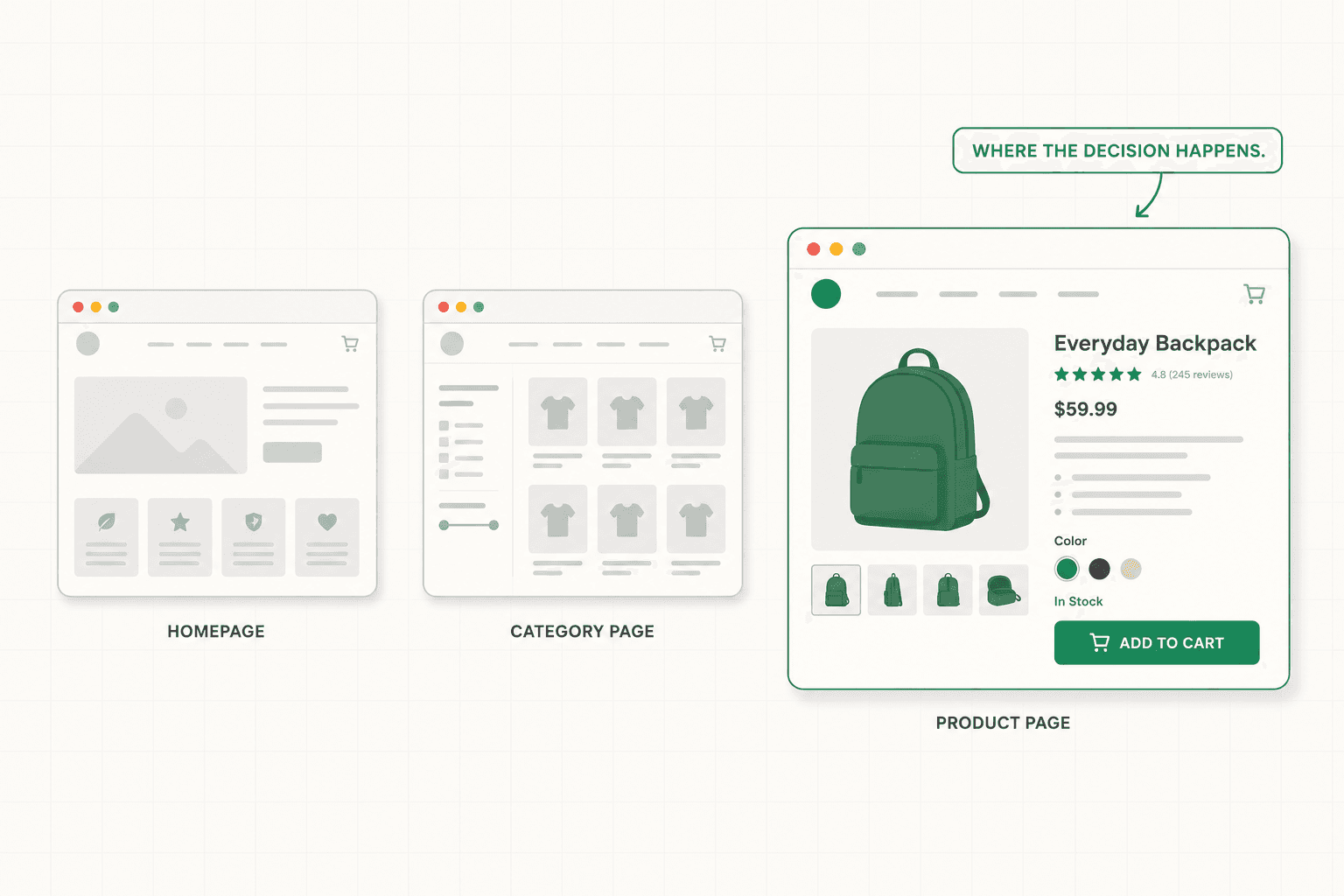
The product page is where the buying decision actually happens. The buyer arrives asking whether they should buy this, from this store, right now. Everything on the page either moves them toward yes or gives them a reason to hesitate, and in ecommerce, hesitation usually means a closed tab.
The product pages that convert well are built to resolve the buyer's uncertainty rather than just display the product. Rich imagery from every angle that matters, so the buyer can see exactly what they are getting. Descriptions that lead with the outcome rather than listing specs. Specific reviews placed near the doubts they resolve. Shipping and return information surfaced clearly so there are no surprises. Each element answers a question the buyer is carrying, and every unanswered question is a hesitation point.
Improving the product page often produces the single largest sales increase available to a store, because it is where the decision happens and because it is usually the least optimized. The full framework is here: Product Page Optimization: What Actually Turns Browsers Into Buyers
Fix the Checkout, Where Committed Buyers Vanish
The checkout handles the most valuable visitors in the entire store, the ones who already decided to buy, and most checkouts give them several reasons to change their minds.
Unexpected costs appearing at the final step. Forced account creation before purchase. Too many fields. Too many steps. Limited payment options. A mobile experience that makes completing the purchase genuinely painful. Each of these is a place where a buyer who wanted the product walks away without it.
Cart abandonment across ecommerce hovers around 70%, which means most stores lose the majority of buyers who got all the way to the cart. These are the most recoverable conversions in the funnel because the intent was already there. Fixing the checkout is not about persuading anyone. It is about removing the obstacles standing between a decided buyer and a completed purchase. The full breakdown of checkout friction is here: Checkout Optimization: How to Build a Flow That Doesn't Lose Buyers
Because the intent is already established, checkout improvements often produce faster and clearer results than almost any other intervention. The buyers are there. They want to buy. Get out of their way.
Increase Average Order Value, Not Just Conversion Rate
Conversion rate is the metric most stores watch, but it is not the only lever on revenue, and focusing on it exclusively misses a significant opportunity.
Revenue is a function of traffic, conversion rate, and average order value. A store can increase sales by improving any of the three. Most stores focus entirely on the first two and neglect the third, even though increasing what each buyer spends is often easier than convincing more buyers to purchase.
The levers here are well established. Thoughtful product recommendations that genuinely fit what the buyer is already interested in. Bundles that offer real value rather than feeling like a cash grab. Free shipping thresholds that give the buyer a reason to add one more item. Volume incentives where they make sense for the product. Each of these can increase what a buyer spends without requiring any additional traffic or any improvement in conversion rate.
The discipline is to do this without adding friction. An upsell that interrupts the checkout can cost more in abandoned carts than it earns in increased order value. The best order value increases happen naturally, at moments where the buyer is already engaged and open, rather than as interruptions at the moment of purchase. Revenue per visitor, which combines conversion and order value, is often a more honest measure of store performance than conversion rate alone.
Recover the Sales You Are Already Losing
Beyond fixing the funnel, there is revenue sitting in the buyers who already left and can be brought back.
Cart abandonment recovery, done well, wins back a meaningful share of buyers who added items and did not complete. These buyers already wanted the product. A timely, helpful reminder with an easy path back to complete the purchase converts a portion of them without requiring any new traffic or any new persuasion. It is some of the cheapest revenue available to most stores.
Similarly, buyers who have purchased before are far easier to sell to again than new buyers are to acquire. Repeat purchase, through email, retention offers, and simply making it easy to buy again, produces revenue at a fraction of the acquisition cost of a new customer. Most stores underinvest here relative to how efficient it is.
Both of these are recovery rather than prevention, and neither substitutes for fixing the underlying funnel. A store with a broken checkout should fix the checkout rather than relying on recovery emails to claw back the buyers it drives away. But once the funnel is sound, recovery captures the sales that slip through anyway, and that revenue is close to free. The full framework for recovery is here: Cart Abandonment: Why Buyers Leave at the Last Step (And How to Get Them Back)
Fix Mobile, Where the Traffic Actually Is
For most ecommerce stores, mobile is now the majority of traffic and a minority of the revenue, and the gap is usually invisible because nobody segments the data by device.
The mobile experience is where friction concentrates. Product images that are hard to inspect on a small screen. Descriptions that require endless scrolling. Add-to-cart buttons that are hard to reach. Checkouts where every field requires tapping and the keyboard covers half the screen. Payment flows that were designed for desktop and adapted badly.
All of this is invisible to teams who build and test on desktop, which is most teams. The result is a store that converts acceptably on desktop and poorly on mobile, and since mobile is a large share of the traffic, the overall loss is significant.
The fix starts with looking. Segment your conversion data by device. If mobile converts at a meaningfully lower rate than desktop, that gap is where your sales are going. Then go through your own store on a phone, as a buyer, and note every point of friction. Each one is revenue you are losing from the majority of your traffic.
The Order of Operations
If you want to increase ecommerce sales, the sequence matters as much as the individual improvements.
Start with diagnosis. Find where in the funnel you are losing the most people. Everything else depends on this.
Fix the biggest leak first. If it is the product page, improve the product page. If it is the checkout, fix the checkout. Applying product page fixes to a checkout problem produces nothing while everyone wonders why the numbers did not move.
Then check mobile specifically, because that is where the losses are usually largest and least visible.
Then look at average order value, which increases revenue without requiring any additional traffic or conversion improvement.
Then add recovery, which captures the sales that still slip through a now-healthy funnel.
And only then, once the store converts well, scale the traffic. Buying traffic for a store that converts well is a good investment. Buying traffic for a store that leaks is paying to fill a bucket with a hole in it.
If you are not sure where your store is losing the most revenue, a structured diagnosis maps the specific leak points before any changes are made. See how the 48h Audit works
The Short Version
Buying more traffic is the most expensive way to increase ecommerce sales. Converting more of the traffic you already have is cheaper, compounds, and makes every future advertising dollar work harder.
Start by finding where in the funnel you are losing people, because the fix depends entirely on the leak. Improve the product page, where the buying decision actually happens and where most stores underinvest. Fix the checkout, where the most valuable visitors in the store vanish for reasons that are almost entirely avoidable. Increase average order value, which grows revenue without needing more traffic or better conversion. Recover the buyers who leave anyway. And check mobile, where most of your traffic is and most of your losses probably are.
Then, once the store converts, scale the traffic. In that order.
Keep reading