How to Write a Case Study That Actually Sells

@nadolconverts
Kacper Nadol

Most case studies are a summary of what was done, written for the company's own records rather than for a skeptical buyer deciding whether to trust them. This article covers how to write a case study that actually moves someone toward a decision.
Why Most Case Studies Do Nothing
A case study exists to answer one question in the mind of a skeptical buyer: did this actually work for someone like me, and would it work for me too? Most case studies never answer that question, because they were written to document what happened rather than to persuade someone deciding whether to trust the company.
The typical pattern is familiar. A short paragraph about the client. A description of what was delivered. A vague closing line about how happy everyone was. It reads like an internal record of a project, filed away as proof that work happened, rather than a piece of content built to move a specific reader closer to a decision.
The buyer reading a case study is not interested in a project summary. They are trying to answer specific questions. Was this client's situation like mine? What was actually broken before? What changed, specifically, and by how much? Is this a one-off result or something that would likely happen again? A case study that does not answer these questions might describe real work accurately and still fail completely at its actual job, which is to move a skeptical reader toward belief.
Start With the Reader's Skepticism, Not the Project Timeline
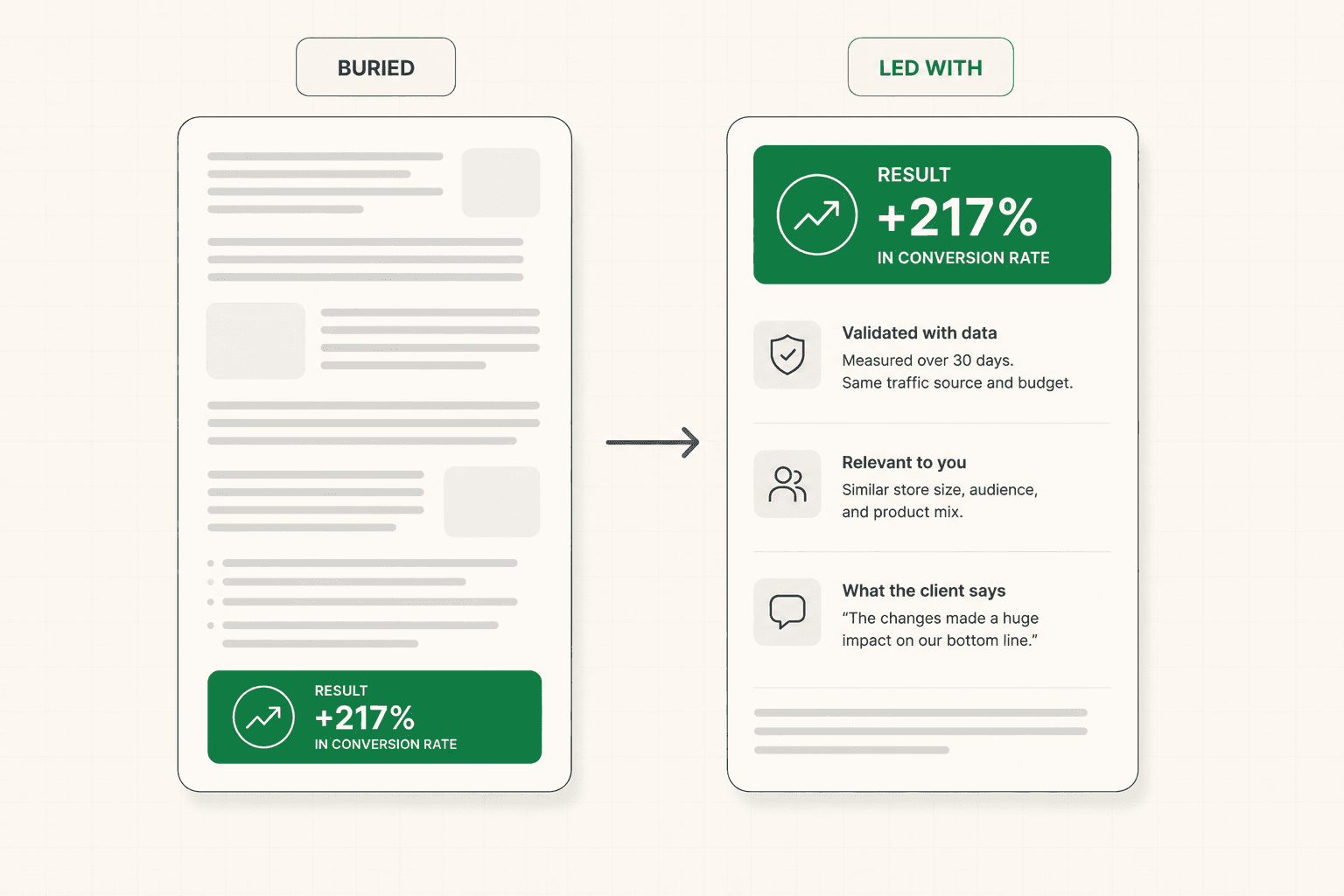
The instinct when writing a case study is to walk through the project chronologically. We were hired, we did discovery, we built the thing, we launched it, here is the result. This structure feels natural because it mirrors how the work actually happened. It is also usually the wrong structure, because it buries the result at the end and makes the reader work through process detail before reaching the part they actually care about.
A stronger approach starts by identifying exactly what the reader is skeptical about, and builds the case study to resolve that skepticism directly. If the reader's biggest doubt is whether a company their size can get this kind of result, the case study needs to establish the client's size and situation immediately, before anything else. If the doubt is about how long results take, the timeline needs to be visible early rather than buried in a paragraph three-quarters down.
This means the same underlying project can produce different case studies depending on who they are written for and what that reader doubts. A case study built to reassure a buyer worried about implementation complexity looks different from one built to reassure a buyer worried about whether the result was a fluke, even if both are describing the same client relationship.
Lead With the Result, Not the Buildup
Most case studies save the result for the end, structured as a story that builds to a payoff. This works in narrative writing and works poorly here, because the reader is scanning, not settling in for a story, and they will not stick around for a payoff they cannot see coming.
The case studies that convert well lead with the result and use everything else to make that result credible. A specific number, a specific outcome, a specific transformation, stated plainly near the top, followed by the context that explains how it happened. The reader who only reads the first few lines still gets the point. The reader who wants the full picture keeps going and finds it.
This does not mean the result needs to be dramatic. It needs to be specific and stated in language the target reader would recognize as meaningful to their own situation. "Increased conversion by 40%" is a fine headline result. "Cut the sales team's time spent on unqualified calls by half, because the leads coming through were finally the right ones" is a stronger one, because it names a specific pain the reader likely shares rather than just a percentage. The same lead-with-outcome logic runs through all conversion copy: Landing Page Copywriting: What Actually Makes It Convert
The Situation Has to Be Specific Enough to Be Recognized
The middle of a case study is where the reader decides whether this client's situation resembles their own, and vague context makes that comparison impossible.
"A growing company needed to improve their online presence" tells the reader nothing they can compare against their own situation. "A twelve-person B2B service business was getting steady traffic from referrals but converting almost none of it because the site never explained what they actually did" gives the reader something concrete to measure their own circumstances against. If they recognize their own situation in that description, the rest of the case study becomes personally relevant rather than abstract.
This is where specificity does double duty. It makes the case study more credible, because vague claims read as marketing while specific ones read as real. And it makes the case study more relevant, because a reader can only see themselves in a story that is concrete enough to compare against. Naming the industry, the company size, the specific problem, and the specific constraint the client was working within all help a reader place themselves inside the story or rule themselves out honestly, which is better than a case study so generic it could apply to anyone and therefore convinces no one in particular.
Show the Mechanism, Not Just the Outcome
A result without an explanation of how it happened reads as luck. The middle section of a strong case study explains the actual change that produced the result, specifically enough that the reader believes it was the cause rather than a coincidence.
This does not require exhaustive process detail. It requires naming the one or two things that actually mattered. If the improvement came from rewriting the homepage to speak to a specific buyer instead of everyone, say that plainly, rather than listing every deliverable in the project. If the fix was structural, a rebuilt checkout flow, a different qualification question on a form, a hero rewritten around a different outcome, name the specific change and connect it directly to the result.
This is also where the case study can quietly teach the reader something, which builds trust independent of the sale. A reader who learns a genuine principle from a case study, that specificity in messaging matters more than polish, that the checkout was losing committed buyers to a hidden cost, walks away having gained something even before they consider hiring anyone. That is a stronger position to sell from than one where the reader feels like they just read an advertisement. The way this kind of specific, mechanism-first proof outperforms vague praise is covered here: Social Proof: How to Use It So It Actually Converts (Not Just Decorates)
Use the Client's Own Words Where You Can
A case study written entirely in the company's own voice, describing its own work favorably, reads as self-promotion no matter how honestly it is written. A case study that includes the client's actual words, in their own language, carries a different kind of weight, because the reader trusts a third party's account more than the seller's account of themselves.
The strongest quotes are specific rather than generally positive. "Great to work with" is forgettable. "I was skeptical this would move the needle given how niche our market is, and then our demo booking rate genuinely doubled the month after launch" is not, because it names the specific doubt, addresses it directly, and gives a concrete result in the client's own voice.
Getting quotes like this usually requires asking specific questions rather than an open-ended request for a testimonial. What were you worried about before we started? What specifically changed? What would you say to someone in a similar position who is on the fence? Questions like these produce quotes with texture and detail rather than generic praise, and that detail is what makes a reader believe the quote is real rather than curated.
Address the Objection the Result Naturally Raises
Every impressive case study result creates a natural skepticism in the reader, and the strongest case studies address that skepticism directly rather than hoping the reader does not notice it.
If the result is dramatic, the natural doubt is whether it is repeatable or a one-off. Addressing that honestly, noting what specific conditions made the result possible, or being clear about what changed and why it would likely apply elsewhere, builds more trust than simply presenting the number and moving on. If the client's situation was unusual in some way, naming that directly, rather than letting the reader discover it and feel misled, keeps the case study credible.
This kind of honesty costs little and buys a great deal. A case study that only ever shows unqualified success reads, correctly, as selective. One that is willing to note a genuine constraint or acknowledge what made the result possible reads as trustworthy, which is the actual currency a case study is trying to build. The habit of naming the thing a skeptical reader would notice before they notice it themselves is one of the more underused moves in persuasive writing generally, and it is the kind of thing I keep coming back to in the newsletter.
Where the Case Study Should Actually Live
A case study written well and buried in a portfolio section nobody visits does no work at all. Where it appears matters almost as much as how it is written.
The strongest placement is next to the specific claim it supports, on the page where a reader is actively forming the doubt the case study resolves. A case study about implementation speed belongs near the section of a page discussing implementation. A case study about lead quality belongs near a claim about qualified leads. A dedicated case studies page still has value for readers who want to dig deeper, but the version doing the most conversion work is the one placed exactly where the relevant skepticism forms, not the one filed away in its own section. The architecture of placing proof at the point of doubt is covered here: B2B Landing Page: What Makes It Actually Work
A Practical Structure to Work From
If you are writing a case study and want a starting structure rather than a blank page, this order tends to work well across most situations.
Lead with the result, stated specifically and in language the target reader would recognize as meaningful. Follow with the client's situation, described concretely enough that the reader can compare it to their own. Name the specific problem that situation was creating, in terms the reader would recognize. Explain the one or two things that actually changed, connected directly to the result. Include a specific quote in the client's own words, ideally addressing a doubt directly. Acknowledge honestly what made the result possible, rather than presenting it as universally repeatable if it was not. And close with something concrete for the reader to do next, matched to how convinced they are likely to be at that point.
If you have case studies already and are not sure whether they are doing any real work on your site, that is worth checking before writing new ones. A structured audit looks at whether your existing proof is placed and written to actually convert. See how the 48h Audit works
The Short Version
A case study exists to resolve a specific skeptical reader's doubt, not to document a project for the company's own records. Most fail because they are written the second way.
Lead with the result stated specifically, not buried at the end of a chronological story. Make the client's situation concrete enough that a reader can compare it honestly to their own. Show the actual mechanism that produced the result rather than presenting the outcome as unexplained luck. Use the client's real words, gathered by asking specific questions rather than requesting generic praise. Address the doubt the result naturally raises rather than hoping the reader does not notice it. And place the case study where the relevant skepticism actually forms, not just in a portfolio section.
Written this way, a case study stops being a record of work completed and starts being one of the more effective pieces of content a business has for moving a skeptical buyer toward a decision.
Keep reading