Landing Pages and SEO: Do They Actually Work Against Each Other?

@nadolconverts
Kacper Nadol

A common worry before building landing pages is that they will create duplicate content, cannibalize existing rankings, or otherwise hurt SEO. The concern is reasonable and mostly comes from mixing up two different kinds of landing pages. This article breaks down how they actually interact.
The Worry Is Reasonable, the Framing Is Usually Wrong
The concern comes up often enough to be worth addressing directly: will building landing pages hurt my SEO? Will Google penalize me for duplicate content? Will a new landing page compete with my existing pages and cannibalize the rankings I already have?
The worry is not irrational. There are real technical issues that can genuinely hurt SEO, and landing pages, built carelessly, can cause some of them. But the worry usually comes from treating "landing page" as a single category with a single relationship to SEO, when in practice there are two fundamentally different kinds of landing pages, and they interact with search in almost opposite ways. Once that distinction is clear, most of the anxiety resolves on its own.
Two Different Kinds of Landing Pages
The first kind is a campaign landing page, built for a specific paid traffic source, often an ad campaign, sometimes with multiple near-identical variants built to test different messages against each other. This kind of page exists purely to convert traffic you are actively sending to it. It has no organic search job at all. Nobody is meant to find it by typing a query into Google. Its entire purpose is to serve visitors who arrive from a specific paid source, and it should generally be built and treated accordingly, which usually means keeping it out of search entirely.
The second kind is an SEO landing page, built to rank for a specific commercial search term and capture organic traffic directly. This is closer in spirit to a blog article than to a campaign page, except it is built around commercial intent rather than educational intent, targeting someone actively searching for a solution rather than someone researching a topic. This kind of page should absolutely be indexed, and it should be built with the same depth, specificity, and genuine usefulness that makes any page rank well.
Most of the confusion about landing pages and SEO comes from applying the logic of one type to the other. Treating a campaign page as if it needed to rank organically, or treating an SEO landing page as if it were disposable ad-campaign content, both produce bad outcomes for different reasons.
Campaign Pages Should Usually Stay Out of Search Entirely
If you are building a landing page specifically to receive paid traffic from a particular ad or campaign, it generally does not need to appear in organic search results, and in most cases it should not. These pages are often narrow in scope, built around a single specific offer or message tied to a specific campaign, and sometimes exist in multiple near-identical variants built to test different headlines or offers against each other.
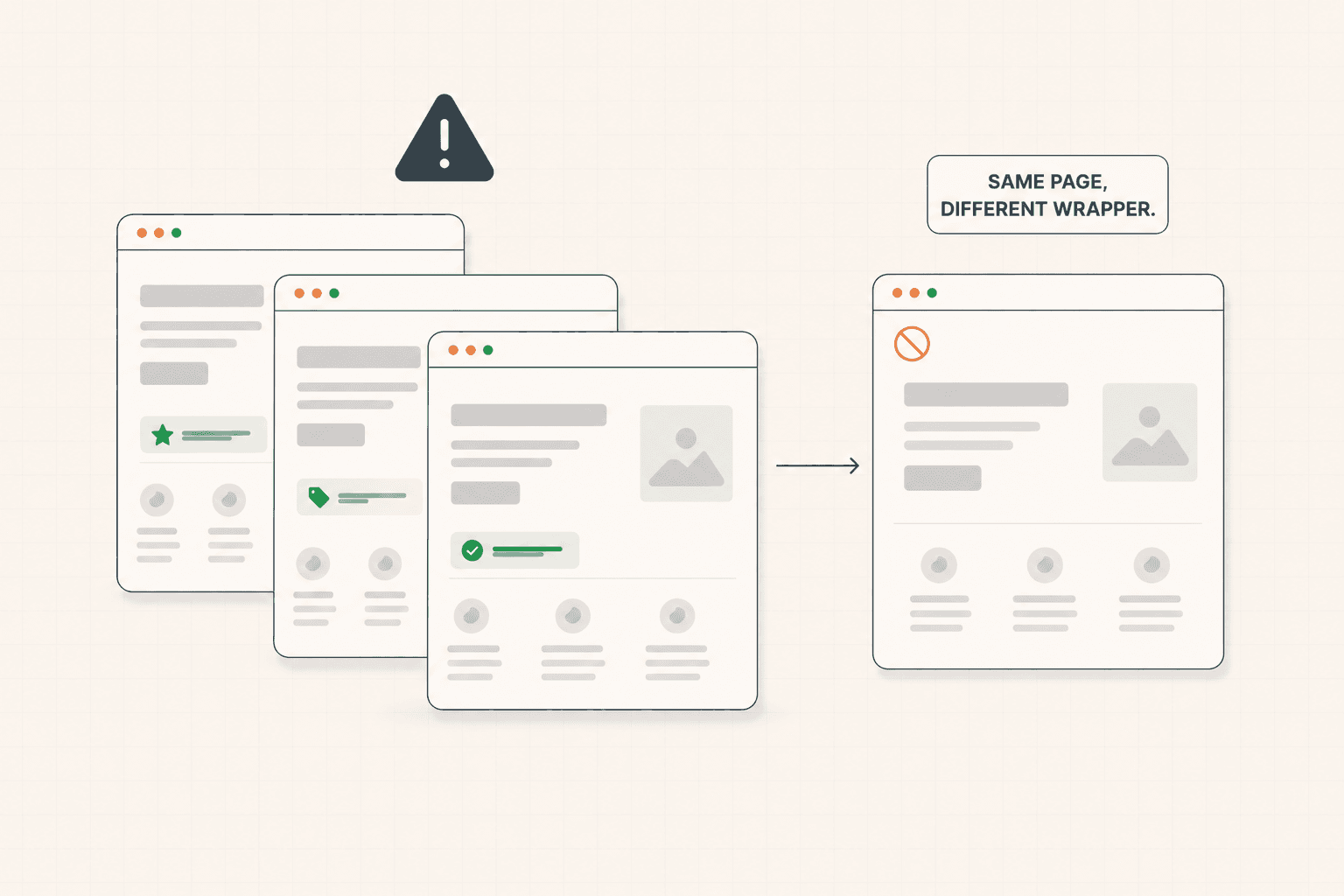
If several of these variants are indexable, search engines can see them as duplicate or thin content, since they are, by design, extremely similar to each other with only small differences. This does not usually cause a dramatic penalty, but it does nothing useful either. The pages were never meant to rank, they add duplicate-feeling content to your site's overall footprint, and they occasionally compete with pages you actually do want to rank.
The straightforward fix is a noindex tag on pages built purely for paid traffic. This tells search engines not to include the page in their index at all, which removes any duplicate content concern entirely and keeps these pages doing exactly the job they were built for: converting the specific traffic you send to them, with no ambition to appear in organic results.
SEO Landing Pages Need to Earn Their Ranking Honestly
An SEO landing page, one built to capture organic traffic around a specific commercial keyword, plays by the same rules as any other page trying to rank. It needs to genuinely satisfy the intent behind the search, provide real depth and specificity, and offer something a thin, templated page cannot.
This is where a second, related worry sometimes surfaces: will a landing page built primarily to convert also be able to rank, or does the commercial focus work against it. The honest answer is that a landing page can rank well if it is built with the same substance that makes any page rankable, genuine usefulness, specific and accurate information, and a structure that actually answers the query, rather than assuming that a strong CTA and a clean design are enough on their own. A page built purely to convert, with thin or generic content wrapped around a form, will usually underperform in search regardless of how well it converts the traffic it does get, because it is not giving search engines a reason to send anyone there in the first place. The full framework for what belongs on a landing page, including the depth that makes it useful rather than thin, is here: Landing Page Checklist: What Actually Needs to Be on the Page (And Why)
The practical implication is that you should not try to build dozens of thin SEO landing pages targeting slightly different keyword variations, hoping volume will compensate for depth. A small number of genuinely strong, specific pages, each built around a real commercial term with real substance behind it, will consistently outperform a large number of thin ones, both in how well they rank and in how well they convert once someone arrives.
Cannibalization Is a Real Risk, and It Has a Specific Cause
The fear of a new landing page cannibalizing an existing page's rankings is legitimate, but it has a specific, identifiable cause rather than being an inherent risk of building landing pages at all.
Cannibalization happens when two or more pages on the same site target the same search intent, forcing search engines to decide which one to rank and often splitting the ranking signal between both rather than concentrating it behind one strong page. This is not caused by having multiple landing pages in general. It is caused by having multiple pages competing for the exact same query without clear differentiation.
The fix is deliberate keyword and intent mapping before pages get built. Each commercial term you want to target organically should have one clear, canonical page built for it, not several. If a new landing page is being created for a term that a blog article or another landing page already targets, the right move is usually to consolidate, redirect, or clearly differentiate the intent each page serves, rather than letting both compete for the same search. This is exactly the kind of planning that determines whether a growing library of pages compounds in strength over time or quietly works against itself. [The way this same blog approaches topic coverage without overlap reflects this discipline directly, and it is a habit worth applying to landing pages the same way.]
Blog Content and Landing Pages Support Each Other, They Do Not Compete
A related worry sometimes surfaces around whether investing in blog content takes away from landing page performance, or the reverse, as if a site has to choose between building topical authority through articles and building conversion-focused landing pages. In practice, the two reinforce each other directly.
Blog content, written around the questions and research-stage searches a buyer makes before they are ready to act, builds topical authority and brings in visitors earlier in their decision process. Landing pages, built around the commercial terms a buyer searches once they are closer to deciding, capture that more direct intent. The blog articles that reference and link to a relevant landing page at the natural point in the argument, rather than forcing the connection, pass both relevance and authority signal to that page, which is a meaningful part of how search engines judge which pages on a site deserve to rank for competitive commercial terms.
This linking relationship is not incidental. A site with strong topical depth around a subject, built through genuinely useful articles that link naturally to the relevant commercial pages, tends to see those commercial pages rank better than the same landing page would sitting in isolation with no supporting content around it. Treating blog content and landing pages as two separate, unrelated efforts misses one of the more reliable ways to make both perform better. This interplay between content depth and commercial page performance is something I come back to a lot in the newsletter, usually with a real example of a site where the connection was either working or completely missing.
A Practical Way to Think About Any New Landing Page
Before building a new landing page, it helps to answer one question first: is this page meant to receive traffic you are actively sending it, or is it meant to attract traffic on its own through search.
If the answer is the first, build it for conversion, keep it out of the search index with a noindex tag, and do not worry about its SEO performance at all, since that was never its job.
If the answer is the second, build it with the depth and specificity that search engines and real buyers both reward, map it to a single clear keyword and intent that no other page on your site is already targeting, and treat it with the same seriousness as any piece of content meant to rank and convert at the same time.
If a page is meant to do both, receive paid traffic now and also rank organically over time, it needs to be built to the SEO standard from the start, since a thin page optimized purely for a specific ad message will rarely satisfy organic search intent well enough to rank regardless of how well it was tagged.
If you are not sure whether your current landing pages are set up correctly, competing with each other, or missing the depth that would let them rank, a structured audit looks at this alongside everything else the site is doing. See how the 48h Audit works
The Short Version
Landing pages and SEO are not naturally in conflict. The worry usually comes from treating two different kinds of pages as if they were one, a campaign page built purely to convert traffic you are sending it, and an SEO landing page built to capture traffic on its own through search.
Keep campaign pages, and their test variants, out of the search index with a noindex tag, since they were never meant to rank and indexing them only creates duplicate content with no upside. Build SEO landing pages with real depth and specificity, mapped to a single clear commercial term, so they earn a ranking honestly rather than relying on volume across thin variants. Watch for cannibalization by mapping intent before building, not after. And treat blog content and landing pages as reinforcing each other rather than competing, since that connection is one of the more reliable ways to improve how both perform.
Built this way, a growing set of landing pages strengthens a site's SEO rather than working against it.
Keep reading