How Long Should a Landing Page Be? The Real Answer

@nadolconverts
Kacper Nadol

Length is one of the most common questions in landing page design and one of the worst framed. The right length is never a fixed number of words or scrolls. This article covers what actually determines how long a landing page should be, and how to know if yours is the wrong length for the wrong reasons.
The Question Is Framed Wrong From the Start
"How long should a landing page be" assumes length is a property of good landing pages in general, something with a right answer independent of what the page is actually trying to do. It is not. The right length of a landing page is a function of how much conviction the ask requires, and that varies enormously depending on the offer, the price, the audience, and how much the visitor already knows and trusts before they arrive.
A page asking for an email address in exchange for a genuinely useful free resource can be short, because the commitment being requested is small and the trust required to grant it is correspondingly low. A page asking a visitor to commit to a significant purchase, a long-term service relationship, or a meaningful change to how their business operates needs to do far more persuasive work, because the size of the ask demands a proportional amount of conviction before a reasonable person will say yes.
This is why "landing pages should be short because attention spans are short" and "long-form pages convert better because they build more trust" are both frequently true and both frequently wrong, depending entirely on which situation they are being applied to. Neither is a rule. Both are describing the correct length for a specific kind of ask, misapplied as a universal principle.
The Actual Variable: The Size of the Commitment
The clearest way to think about landing page length is to start with the size of the commitment you are asking for, then build a page with enough persuasive content to justify that commitment, and stop there.
A low-commitment ask, downloading a guide, signing up for a free tool, entering an email for a discount, requires relatively little convincing. The visitor's downside if they are wrong is small, so the bar for action is low, and a page that establishes relevance quickly and makes the offer clear can convert well without much additional length. Padding a low-commitment page with extensive proof, detailed objection handling, and a long case for why the offer matters usually does not help conversion and sometimes hurts it, because it treats a small decision as if it were a large one and makes the visitor wonder why so much convincing is necessary for something so simple.
A high-commitment ask, a significant purchase, a long-term service engagement, a decision that involves real switching costs or real risk if it goes wrong, requires real conviction before a reasonable visitor will act. A short page that states the offer and asks for the commitment without addressing the objections, proof, and context a serious buyer needs will lose visitors not because the page was too long but because it was too short to actually make the case. The framework for what a service-relationship page specifically needs to establish is here: Service Page: How to Write One That Turns Visitors Into Booked Calls
Traffic Temperature Changes the Right Length Too
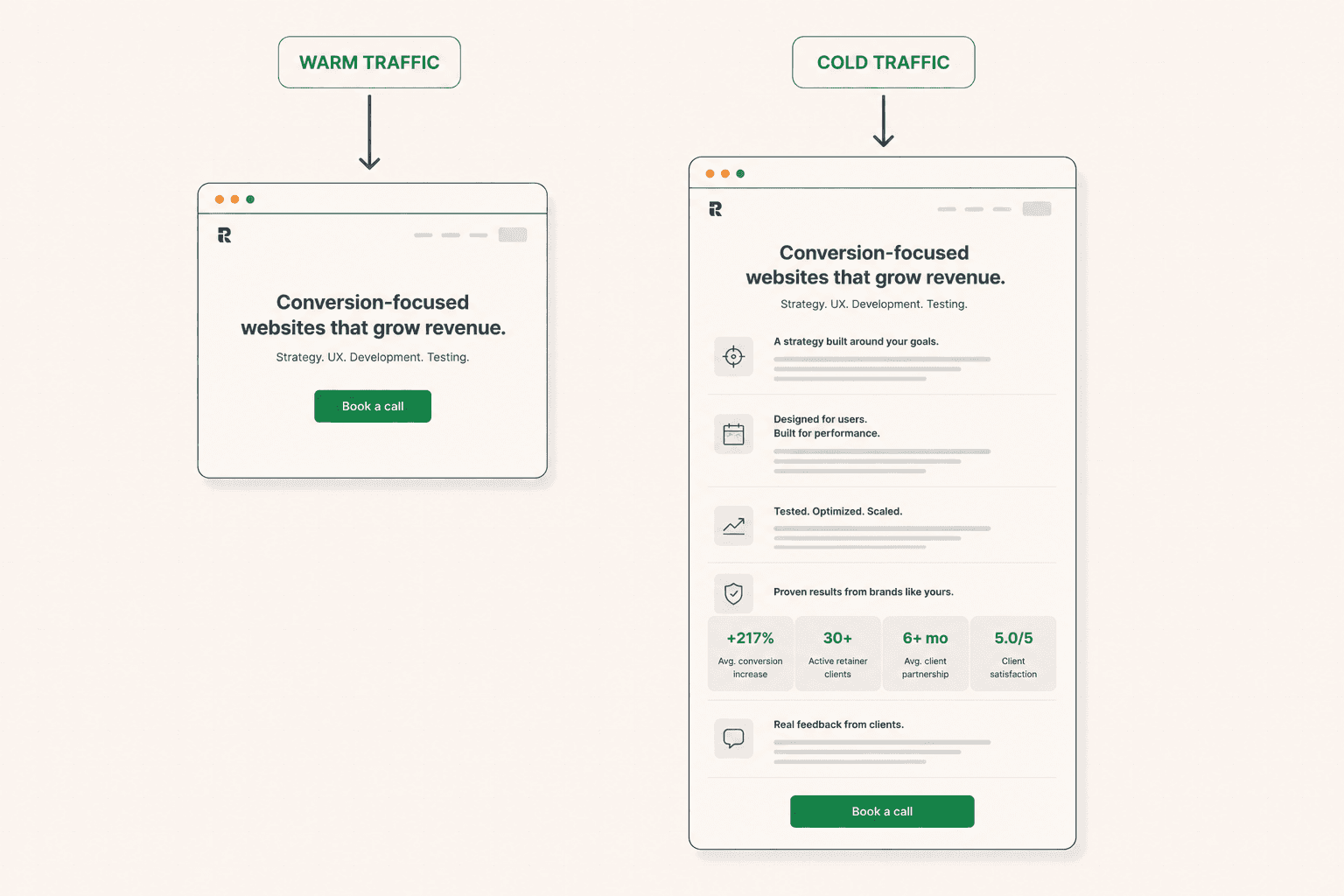
The same offer, at the same price, needs a different length depending on how much the visitor already knows and trusts before they arrive, which means length is not just a function of the offer but of the specific traffic hitting the page.
A visitor arriving from a warm source, an email to an existing list, a referral from someone they trust, a retargeting ad after multiple prior visits, already carries context and some baseline trust. A shorter page can convert this visitor well, because much of the persuasive work has already happened somewhere else before they landed. The page's job is closer to confirming a decision that is mostly already made than building one from nothing.
A visitor arriving cold, from a broad paid campaign or an unfamiliar search result, has none of that context. The page is doing the entire job of building relevance, trust, and conviction from a standing start, and a short page asking a cold visitor for a significant commitment is asking them to trust a stranger based on very little evidence. This is why the same offer can genuinely need a longer page for cold acquisition traffic and a shorter one for a warm retargeting campaign, even though the product and the price have not changed at all. The way traffic temperature should shape page decisions generally is covered here: Landing Page Copywriting: What Actually Makes It Convert
Length Is Not the Same as Word Count
A page can be long in terms of scroll distance and short in terms of actual reading, or the reverse, and this distinction matters more than the raw length of the page.
A long page made of dense paragraphs the visitor has to read carefully to extract meaning feels far longer, and creates far more friction, than a page of the same total word count broken into scannable sections with clear hierarchy, generous whitespace, and content the visitor can absorb by skimming headlines and glancing at key lines. The perceived length of a page, which is what actually determines whether a visitor keeps going or gives up, is shaped as much by how easy the content is to process as by how much of it there is.
This means the fix for a page that feels too long is often not cutting content but restructuring it. Breaking dense paragraphs into shorter ones. Using subheadings that let a visitor track the argument without reading every word. Pulling out the most important claims so they are visible at a glance rather than buried in the middle of a paragraph. A page can retain the same persuasive content and feel meaningfully shorter simply by making that content easier to move through. The way hierarchy and scannability affect how a page reads is covered here: Website Copywriting: What Actually Makes a Site Convert (And Where Most Copy Fails)
The Real Test Is Whether Every Section Is Earning Its Place
Rather than targeting a specific length, the more useful discipline is to evaluate every section of the page against a single question: is this section reducing a specific doubt or building a specific piece of the case, or is it here because it felt like something a landing page should have.
Sections that pass this test earn their length regardless of how long the page becomes. A detailed case study that resolves a genuine skepticism about whether the result is repeatable is not padding, even if it adds significant length, because it is doing real persuasive work that the page needs. A features section that restates the same value proposition three different ways with no new information is padding regardless of how short it is, because it adds length without adding anything the visitor needed.
This reframes the length question entirely. The right question is never "is this page too long" or "is this page too short" in the abstract. It is "does every section here need to exist, and is there a doubt or a piece of the argument that still needs addressing that isn't here yet." A page assembled this way ends up the right length by construction, rather than by hitting some external target. The full framework for what belongs on a page and why is here: Landing Page Checklist: What Actually Needs to Be on the Page (And Why)
Signs Your Page Is the Wrong Length
A few patterns are worth checking for directly, because they show up often and point clearly in one direction or the other.
If visitors are dropping off heavily partway through a long page, and the sections after the drop-off point are restating value the visitor has already absorbed rather than introducing new information or resolving new doubts, the page is likely too long in the specific place it is losing people, and trimming there would probably help more than trimming elsewhere.
If visitors reach your CTA and hesitate or leave, and you know from sales conversations that they still had real, specific questions the page never addressed, the page is probably too short for the size of the ask, regardless of how it currently scrolls.
If your page converts a reasonable percentage of visitors but those visitors report feeling like they did not have enough information to feel confident, that is a length problem disguised as something else, and the fix is adding the specific missing content rather than a general instinct to make the page longer.
If the page is long and converting well but you suspect some sections could be cut, the way to find out is testing removal against a control, not assuming shorter is automatically better. Length itself is not the lever. What each section is doing for the visitor is the lever, and length is just the visible symptom of how many things the page decided needed to be said.
How to Decide the Right Length for Your Page
Start with the size of the ask. A low-commitment offer needs less convincing than a high-commitment one, and building a longer page than the ask requires usually hurts more than it helps.
Consider the traffic temperature the page is primarily serving. Cold, unfamiliar traffic generally needs more context and conviction built into the page itself than warm traffic that arrives with existing trust.
List the specific doubts a realistic visitor would have before committing to your ask, and make sure the page addresses each one somewhere, regardless of how long that makes it.
Then check whether every section beyond that list is earning its place, or whether some of it exists out of habit rather than because it is doing real persuasive work.
If you are not sure whether your current page is too long, too short, or simply missing the wrong things in the wrong places, a structured audit identifies the specific gaps rather than guessing at a target word count. See how the 48h Audit works
The Short Version
There is no correct length for a landing page in the abstract, because length should follow from what the page is actually trying to accomplish, not from a rule applied regardless of context.
A low-commitment ask needs less convincing and can be short. A high-commitment ask needs real conviction and usually needs to be longer to earn it honestly. Warm traffic that already carries trust needs less page than cold traffic starting from nothing. And perceived length, shaped by hierarchy and scannability, matters as much as actual word count.
The real discipline is not targeting a length. It is making sure every section on the page is either resolving a genuine doubt or building a genuine piece of the case, and cutting or adding based on that, rather than on a number.
Keep reading