Service Page: How to Write One That Turns Visitors Into Booked Calls

@nadolconverts
Kacper Nadol

A service page is not a landing page in the strict sense, and treating it like one is where most agencies, consultants, and B2B service businesses go wrong. This article covers what a service page actually needs to do and why most of them fail to book a single call.
A Service Page Is Selling Something Different
A landing page for a product usually sells a single, well-defined transaction. Sign up for the trial. Buy the item. Download the guide. The visitor evaluates a discrete thing and decides whether to acquire it.
A service page is selling something structurally different: an ongoing relationship with a person or a team, whose actual work has not happened yet and whose quality the visitor cannot fully evaluate in advance. This changes what the page needs to do. It is not just persuading someone to take an action. It is building enough trust that a stranger is willing to commit time, money, and often a meaningful amount of vulnerability, since hiring someone usually means admitting something is not working, to a relationship whose outcome they cannot fully verify beforehand.
This is why service pages built with landing page logic, a punchy headline, a feature list, a single CTA, so often underperform. They treat the decision as a transaction when the visitor is actually evaluating a relationship. Agencies, consultants, freelancers, and B2B service businesses need a page that does the trust-building work a product page can skip, because a buyer purchasing software is taking on far less risk than a buyer hiring a person or team to do unproven work on their business.
The Core Question the Page Has to Answer
A visitor on a service page is asking a version of the same question regardless of industry: can I trust this person or team to actually deliver what they are describing, for a problem like mine, without me having to manage the relationship closely to make sure it goes well?
Every element on the page should be evaluated against whether it helps answer that question. A feature list of what the service includes answers a smaller, less important question. A page full of process detail with no evidence of past results answers a different question than the one the visitor is actually asking. The visitor does not primarily want to know what you do. They want to know whether they can trust you to do it well for them specifically.
This reframes what belongs on the page. Credentials, specific past results, a clear description of who the service is for and who it is not for, and a low-friction way to start a conversation all directly serve the trust question. A long list of deliverables or a dense explanation of methodology, while sometimes useful supporting detail, rarely does the primary persuasive work by itself. The same buyer-first framing runs through all conversion work: Why Your Landing Page Doesn't Convert: 9 Real Reasons (And What to Fix First)
Specificity About Who This Serves Matters More Here Than Almost Anywhere
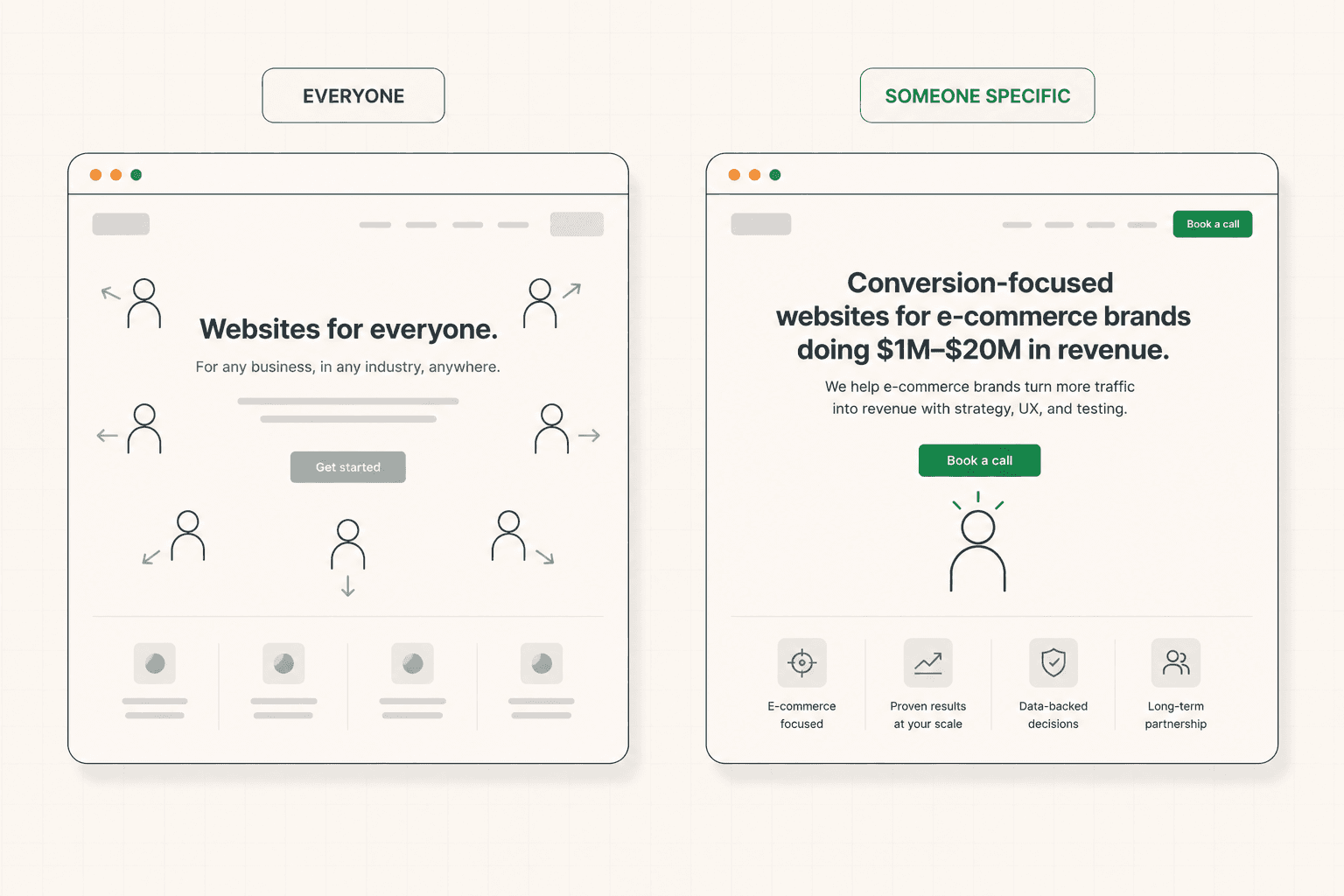
Service businesses are especially prone to writing pages that try to serve everyone, because most service providers can technically help a wide range of clients. The instinct to avoid excluding potential business produces a page so broad it fails to convince anyone.
A service page that says "we help businesses grow" could be describing almost any service business in existence. A visitor reading it learns nothing about whether this particular provider understands their specific situation. A service page that says "we work with B2B service businesses between five and fifty employees who are getting referrals but have no website that explains what they actually do" gives a visitor in that exact situation an immediate sense that this provider understands people like them specifically, and gives a visitor outside that description a fast, honest signal that this may not be the right fit.
Narrowing who a service page speaks to feels like it should reduce leads, and it usually does reduce raw volume while increasing the quality and conversion rate of the leads that do come through, because the visitor who books a call after reading a specific description already believes their situation matches what the provider handles well. The full mechanics of this trade-off are covered here: How to Qualify Leads on Your Website Without Killing Conversions
Show the Process, But Only Enough to Reduce Anxiety
Service pages often either omit process entirely, leaving the visitor with no sense of what working together would actually involve, or explain it in exhaustive detail that reads more like internal documentation than persuasive copy. Both miss the actual job the process section is supposed to do.
The process section exists to reduce the specific anxiety of not knowing what happens after someone reaches out. Will this be a long, awkward sales process? What actually happens on the first call? How long does the work take? What is expected of me during it? A short, clear outline of the actual steps, kept to what genuinely matters to a first-time visitor rather than everything the provider does internally, resolves this anxiety efficiently.
The right level of detail is usually three to five steps, described in a sentence or two each, focused on what the client experiences rather than what the provider does behind the scenes. "We start with a short call to understand your situation, then send a proposal within a few days, then begin work with clear milestones" tells the visitor what to expect without overwhelming them with internal methodology they were never going to read carefully.
Proof Needs to Address the Relationship, Not Just the Result
Service page proof does more work when it addresses not just what happened but what the relationship itself was like, because the visitor is evaluating both the outcome and the experience of working together.
A testimonial that only states a result, "revenue increased 30%," answers half the question a visitor is actually asking. A testimonial that also speaks to the working relationship, responsiveness, communication, whether the provider understood the business, whether the process felt collaborative or like pulling teeth, answers the other half. Since the visitor is committing to an ongoing relationship rather than a single transaction, evidence about what that relationship is actually like carries real weight.
This means the questions worth asking past clients for a service business testimonial are slightly different from the ones that produce a strong product testimonial. Alongside the result, it is worth asking what the process of working together was actually like, and what, if anything, surprised them. Answers to these questions produce quotes that speak to the relationship question a service buyer is specifically weighing. The broader framework for gathering and using proof effectively is here: Social Proof: How to Use It So It Actually Converts (Not Just Decorates)
The CTA Should Match the Actual Weight of the Decision
Hiring someone is a heavier decision than most product purchases, and a service page CTA that treats it like a lightweight transaction, a bare "Contact Us" button with no context, fails to acknowledge the actual weight of what it is asking.
The strongest service page CTAs describe specifically what happens when someone clicks, and frame the immediate next step as low-risk relative to the larger decision it is not yet asking for. "Book a free 20-minute call to see if this is a fit" is a smaller, more honest ask than "Hire us," even though both lead toward the same eventual relationship. The visitor is not being asked to commit to months of work. They are being asked to have one conversation, and framing the CTA around that smaller, real commitment removes the anxiety of feeling like a single click is a large decision.
Supporting copy around the CTA that addresses the specific fear of a heavy-handed sales process, "no pitch, just figuring out if this makes sense," does real work here, because many potential clients hesitate specifically because they imagine an aggressive sales conversation rather than a genuine conversation about their situation. The full framework for calibrating a CTA to actual readiness is here: Call to Action Examples: What Actually Makes a CTA Convert (Beyond Button Color)
Who the Provider Is Matters More Here Than on a Product Page
For service businesses, especially small or solo ones, the person or people doing the work are often as important to the decision as the service itself. A product page can be almost entirely about the product. A service page usually cannot be entirely about the process, because the visitor is also evaluating whether they trust the specific people they would be working with.
This is where a genuine, specific about section or founder story earns real space on a service page in a way that would feel out of place on many product pages. Not a generic biography, but something that gives the visitor a concrete sense of who they would actually be working with and why that person understands their situation. For solo operators and small teams especially, this personal element is often doing meaningful trust-building work that a more corporate, faceless page cannot replicate.
The honest note here, having built pages like this for a long time, is that the personal element works because it is genuine, not because it is a technique. A founder story added because "service pages should have one" reads as hollow. One that reflects something real about why the provider does this work resonates in a way that is hard to fake and worth investing real thought into, which is the kind of thing that comes up often in the newsletter.
Common Mistakes on Service Pages
A few patterns show up repeatedly and are worth naming directly.
Leading with a long feature list of everything included in the service, rather than the outcome the client actually cares about. The deliverables matter, but they are supporting evidence, not the main argument.
No indication of who the service is not a good fit for, which forces every visitor to guess whether they qualify and often produces unqualified inquiries from people who were never a realistic fit.
A generic, faceless tone on a page representing a small team or solo operator, when the personal element is actually one of the strongest trust-building assets available.
A CTA that asks for too much, treating the first click as equivalent to a hiring decision rather than the smaller, lower-risk first conversation it actually is.
Proof that only states results without any indication of what the working relationship was actually like, missing half of what a service buyer is evaluating.
How to Improve Your Own Service Page
Read your page and ask whether a specific visitor, in a specific situation, would feel like this was written for them, or whether it reads as something that could apply to almost any client of almost any similar business.
Check whether the page tells a visitor who this is not a good fit for, as clearly as it tells them who it is for. If it only describes an ideal client without any honest boundary, it is probably too broad to convince anyone specifically.
Look at your proof and ask whether it addresses only the result or also the experience of working together. If it is only results, some of your strongest available evidence is likely missing.
Check the CTA and the copy around it. Does it ask for something proportionate to a first conversation, or does it feel like it is asking for a full commitment before the visitor has any reason to trust you yet?
If you are not sure whether your service page is doing its job, a structured audit identifies the specific gaps before you rewrite anything. See how the 48h Audit works
The Short Version
A service page is selling an ongoing relationship whose outcome the visitor cannot fully verify in advance, which makes it a different problem than a product landing page, even though the two get built with the same template constantly.
Answer the trust question directly rather than leading with a feature list. Be specific about who this serves and who it does not, even though narrowing feels risky. Show enough process to remove anxiety without drowning the page in internal detail. Use proof that speaks to the working relationship, not just the result. Calibrate the CTA to the actual weight of a first conversation rather than treating it like a full hiring decision. And let the people behind the service be genuinely visible, because for many service businesses, that is where a meaningful share of the trust actually gets built.
Keep reading